Disclosure: This post contains affiliate links. If you purchase through our links, we may earn an affiliate commission at no extra cost to you. As an Amazon Associate, we earn from qualifying purchases.
If you have curious toddlers or pets that investigate every kitchen baseboard and garden path, you may hesitate to use borax or commercial insecticides inside your home. While our borax ant killer recipe is the gold standard for outdoor mounds, households with animals often demand a 100% food-grade alternative.
That is where pure baking soda (sodium bicarbonate) comes in. It is inexpensive, completely non-toxic to dogs and cats, and lethal to ants when prepared with the correct attractant ratios.
This guide is part of our comprehensive collection of pet-safe ant killers and connects to our core hub on natural ant killers. Below is the exact recipe, the biological mechanism behind why it works, and common preparation mistakes to avoid.
How Does Baking Soda Kill Ants?
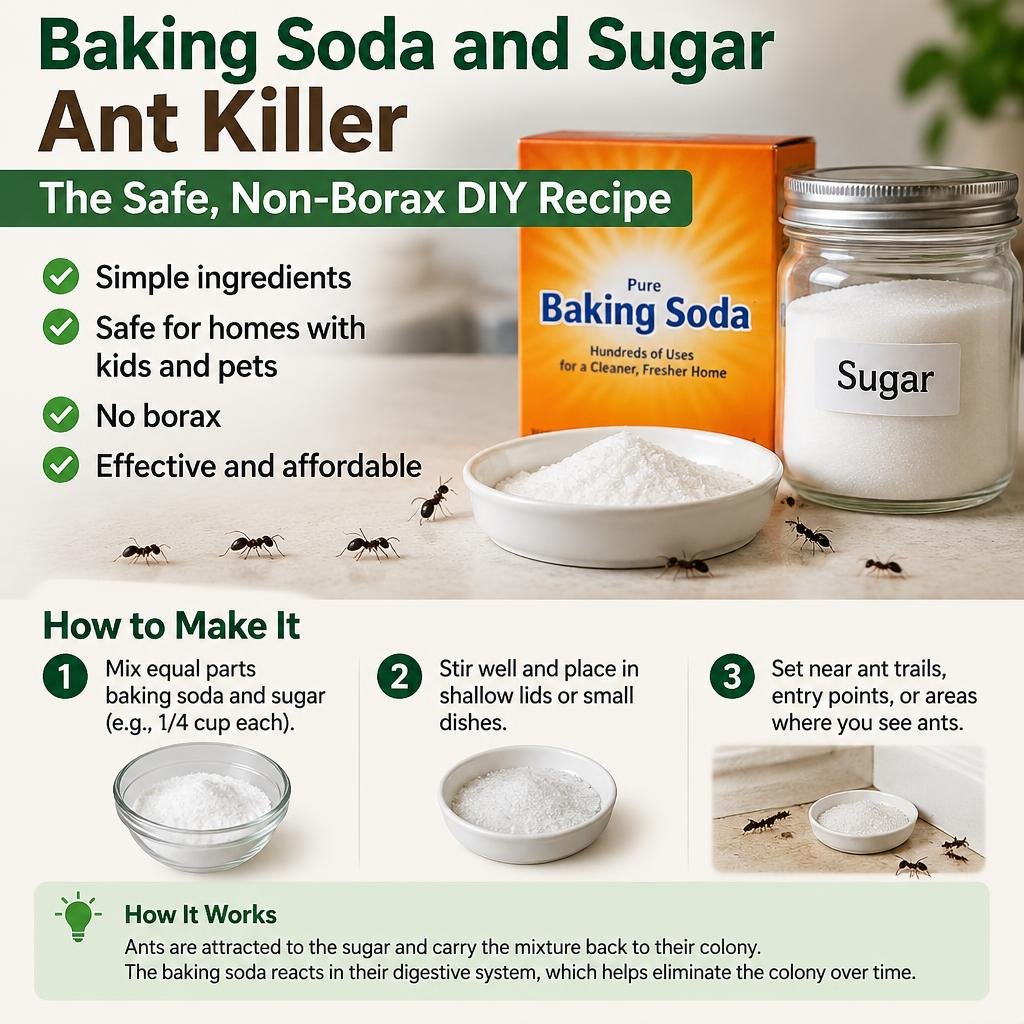
Unlike humans, ants have a highly acidic digestive tract that processes food. When an ant consumes sodium bicarbonate (baking soda), it reacts with the acidic digestive fluids in their stomach, releasing carbon dioxide gas.
Because ants have a rigid, unyielding exoskeleton and lack the physiological ability to expel gas through burping, the internal pressure causes cellular rupture and dehydration within 24 to 48 hours. By blending baking soda with an irresistible powdered sugar attractant, worker ants consume the bait and carry it back to the colony to feed the larvae.
Recommended Pantry Essential: Pure Sodium Bicarbonate (Baking Soda)
100% pure food-grade sodium bicarbonate with zero chemical additives. Safe to deploy along indoor baseboards, pantry corners, and around pet food bowls.
Check Pure Baking Soda on Amazon →Natural DIY Bait Comparison Matrix
| DIY Bait Method | Mode of Action | Pet Safety Rating | Speed to Colony Eradication | Best Use Location |
|---|---|---|---|---|
| Baking Soda + Powdered Sugar | Internal $CO_2$ pressure & cellular dehydration | 100% Pet Safe (Food grade) | 3 to 5 Days | Indoor kitchens, pantries, pet eating areas |
| Borax + Warm Sugar Syrup | Cellular metabolic inhibition | Toxic to pets if ingested in quantity | 48 to 72 Hours | Outdoor mounds, enclosed perimeter bait stations |
| Food-Grade Diatomaceous Earth | External mechanical lipid laceration | 100% Pet Safe (Avoid inhaling dust) | 24 to 48 Hours | Baseboards, foundation perimeter barriers, soil dry lines |
| Cornmeal / Polenta | Digestive block myth (Ineffective alone) | 100% Pet Safe | Poor / Inconsistent | Not recommended for active infestations |
The Master 1:1 Powdered Recipe
The single biggest reason baking soda baits fail is using regular granulated table sugar. Granulated sugar crystals are larger than baking soda powder. Ants have microscopic sensory antennae that can easily separate the sweet sugar crystals from the slightly salty baking soda grains, eating only the sugar!
The Golden Rule: You must use powdered confectioner’s sugar. The ultra-fine particles bind electrostatically to the baking soda grains, making it impossible for the ant to separate them.
- 1/2 Cup Pure Baking Soda
- 1/2 Cup Powdered Sugar (Confectioner’s Sugar)
- Optional Attractant: 1/2 teaspoon cocoa powder or powdered milk for added scent attraction.
Preparation & Placement:
- Whisk the baking soda and powdered sugar together thoroughly in a dry bowl until completely uniform.
- Spoon 1 to 2 tablespoons into shallow plastic lids, jar lids, or cut pieces of cardboard.
- Place the bait stations directly along active ant trails near baseboards, under sinks, or along exterior foundation entry points.
- Keep the bait dry. If the powder absorbs atmospheric moisture or gets wet, discard and replace with fresh dry powder.
The 72-Hour Colony Eradication Timeline
Do not expect instantaneous knockdowns when using dry ingestion baits. Baking soda operates on a delayed biological curve to ensure worker ants transport the lethal agent deep into the subterranean nest:
- Hour 0 to 12 (Recruitment): Scout ants discover the sweet powdered sugar aroma and lay down recruitment pheromone trails back to the nest. You will temporarily see an increase in ant numbers around the lid—this is normal and indicates success!
- Hour 12 to 36 (Trophallaxis): Returning foragers share the ingested sugar-soda mixture with nursery tenders, developing larvae, and reproductive queens via mouth-to-mouth trophallaxis.
- Hour 36 to 72 (Colony Collapse): Internal digestion activates carbon dioxide gas expansion. As worker numbers plummet and the queen stops laying eggs, pheromone maintenance trails decay, resulting in total colony abandonment.
Weatherproofing Bait Stations for Outdoor Raised Beds
High humidity and morning dew turn powdered baking soda into a hardened crust that ants ignore. When placing stations outside around vegetable gardens or patio bricks, build an enclosed moisture shield:
- Take a clean plastic butter tub or yogurt container with a snap-on lid.
- Using a box cutter or heated nail, puncture two small 1/4-inch entrance holes roughly 1/2 inch from the bottom edge.
- Pour 2 tablespoons of dry baking soda and powdered sugar mixture onto the inside floor and snap the lid closed.
- Place the container horizontally along your raised bed border. Rain and overhead sprinklers bounce off the lid while foraging ants slip through the side holes.
Combining with Diatomaceous Earth for Faster Results
While the baking soda bait works internally from ingestion, you can accelerate colony elimination by pairing it with an external mechanical barrier of food-grade diatomaceous earth.
- Dust a fine line of food-grade DE across exterior doorways, windowsill cracks, and garage thresholds.
- Any ants navigating around the bait station will cross the DE barrier, dehydrating externally while the baking soda disrupts them internally.
Dual Action Defense: Certified Food-Grade Diatomaceous Earth
Certified 100% pure food-grade powder that complements your baking soda stations. Provides an impenetrable physical desiccant barrier along foundation cracks and indoor entryways.
Check Food-Grade Diatomaceous Earth on Amazon →Frequently Asked Questions
How long does baking soda take to kill ants?
Baking soda works within 24 to 48 hours after ingestion. Because it is a slower mechanical reaction, you should notice significant reductions in trailing activity by Day 3 to Day 5.
What if my dog or cat licks the bait?
Both baking soda and powdered sugar are standard human food ingredients. In small amounts, baking soda is non-toxic to dogs and cats, making this one of the safest indoor pest control recipes available.
Will sprinkling baking soda directly onto soil harm vegetable plants?
Baking soda contains sodium, which can accumulate in garden soil and increase salinity if dumped in large volumes directly over plant root systems. Always keep your bait inside shallow dishes or lids rather than broadcasting it into growing media. For safe in-soil drenching, use our organic protocols for treating ants in the garden naturally.
Can I mix baking soda with honey or syrup instead of powdered sugar?
Yes. A thick paste made from 1 part baking soda and 2 parts raw honey or maple syrup is very effective for carpenter ants and Argentine ants that prefer liquid sugars over dry powders. Place pea-sized drops on wax paper along foraging paths.
Written by Jennifer Reynolds
Certified Master Gardener • Sustainable Agriculture Specialist
Jennifer has over 15 years of hands-on experience in organic horticulture, permaculture soil biology, and non-toxic integrated pest management (IPM). Every recipe and garden strategy published on Organic Gardening Advise is field-tested in real raised beds to verify safety, dilution accuracy, and effectiveness. Learn more on our About Page.
Leave a Reply