
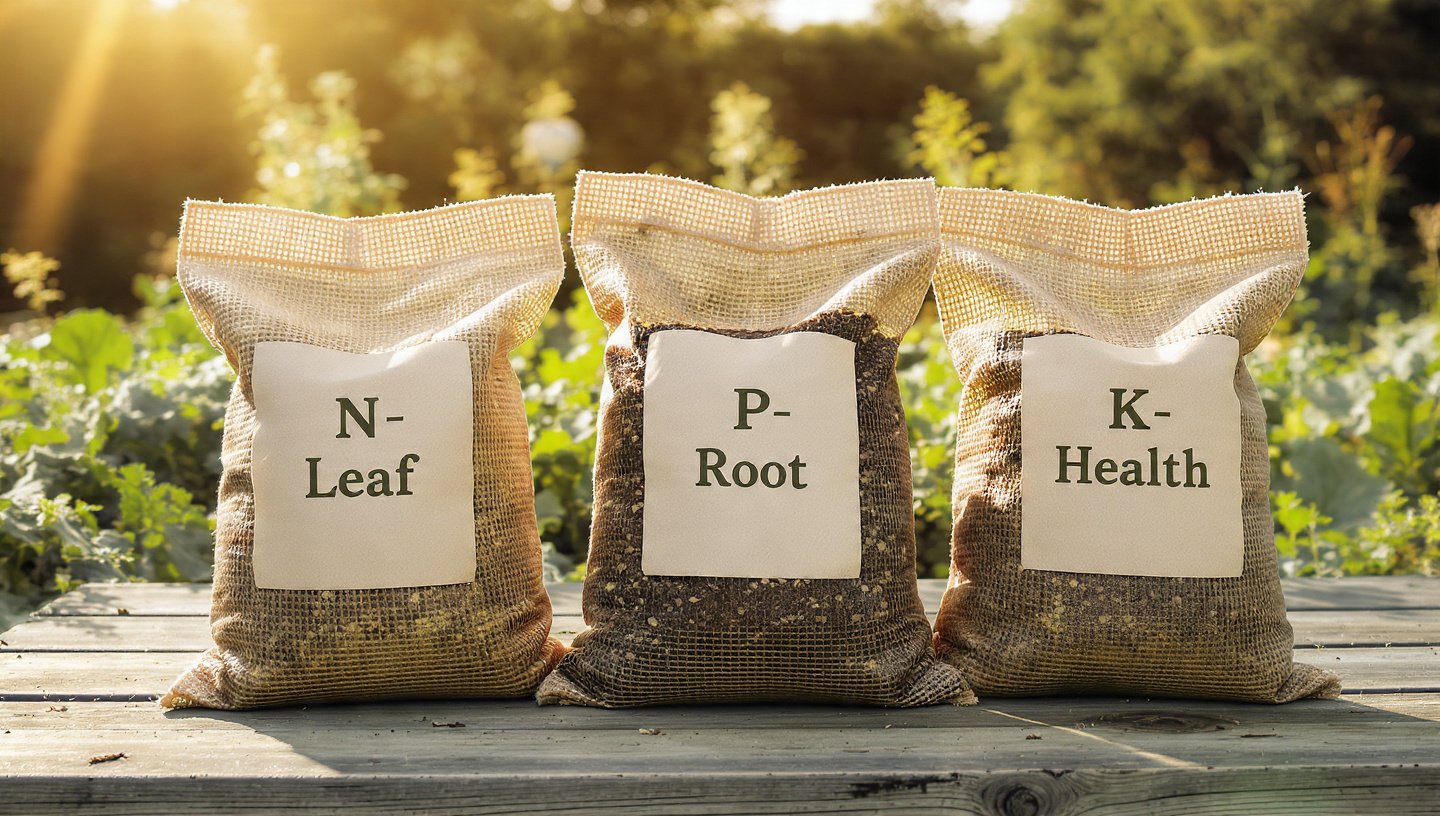
You’re standing in the garden center aisle. You see walls of bags. Some say 10-10-10. Others say 4-6-3. Some promise “Big Blooms,” while others promise “Green Lawns.”
You just want to feed your tomatoes without killing them.
The secret to decoding these bags isn’t a degree in chemistry—it’s three simple letters: N – P – K.
Understanding these three numbers is the difference between a plant that produces lush green leaves but zero fruit, and a plant that gives you a record-breaking harvest.
Here is the simple, jargon-free guide to reading fertilizer numbers and choosing the right organic food for your garden.
Quick Summary: The “Cheat Sheet”
The three numbers on every fertilizer bag represent N (Nitrogen), P (Phosphorus), and K (Potassium).
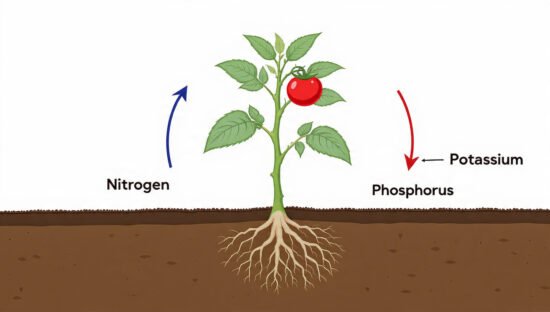
- N (Nitrogen) = “Up”: Fuels green, leafy growth above ground.
- P (Phosphorus) = “Down”: Fuels strong roots and flower/fruit production.
- K (Potassium) = “All Around”: Fuels overall plant health and immunity.
- Memory Trick: Remember the phrase “Up, Down, All Around.”
The Big 3: Breaking Down N-P-K
Every plant needs these three “macronutrients” to survive, but they need them at different times.
1. The First Number: Nitrogen (N) – The “Leafy” One
- What it does: Nitrogen is the engine of growth. It is responsible for making chlorophyll (the green stuff).
- Use it for: Leafy greens (Lettuce, Kale, Spinach), Corn, and grass.
- Signs of deficiency: Pale yellow leaves and stunted growth.
- Organic Sources: Blood Meal, Feather Meal, Fish Emulsion.
2. The Second Number: Phosphorus (P) – The “Fruity” One
- What it does: Phosphorus focuses on the “sexy” parts of the plant: the roots, the blooms, and the fruit.
- Use it for: Tomatoes, Peppers, Carrots, and flower beds.
- Signs of deficiency: Purple veins on the underside of leaves; plants that look green but never flower.
- Organic Sources: Bone Meal, Rock Phosphate.
3. The Third Number: Potassium (K) – The “Health” One
- What it does: Potassium is the plant’s immune system. It helps the plant move water and nutrients around and protects it from cold, heat, and disease.
- Use it for: Everything needs Potassium, but root vegetables (Potatoes, Beets) love it.
- Signs of deficiency: Brown, crispy edges on leaves.
- Organic Sources: Kelp Meal, Langbeinite, Greensand.
Organic vs. Synthetic: Why It Matters
You might see a blue box of “Miracle” chemical fertilizer with huge numbers like 24-8-16. Then you see an organic bag with low numbers like 4-4-4.
You might think: “The chemical one is stronger, so it’s better value, right?”
Wrong.
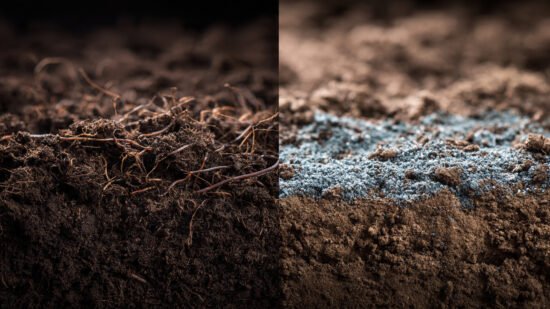
- Synthetic Fertilizers are like an energy drink. They give the plant a massive sugar rush of nutrients instantly, but they do nothing for the soil. Over time, the salts in them can actually kill the beneficial worms and microbes in your dirt.
- Organic Fertilizers are like a slow-cooked meal. They feed the soil microbes, which then break down the nutrients and feed the plant exactly when it needs it. They are impossible to “overdose” if used correctly.
Pro Tip: If you used our Best Organic Soil Mix for Raised Beds, your soil is already rich in organic matter. You likely only need a light “All Purpose” organic fertilizer (like a 4-4-4) once a season.
Which Bag Should I Buy?
Don’t get overwhelmed. For 90% of home gardeners, you only need two types of fertilizer in your shed.
1. The “All-Purpose” Blend (Balanced)
- Look for numbers like: 4-4-4 or 5-5-5.
- Use this for: Everything. If you are a beginner, just buy one bag of “All Purpose” organic granular fertilizer. Mix it into your beds at the start of spring.
2. The “Bloom Booster” (High Middle Number)
- Look for numbers like: 2-8-4 or 3-7-4.
- Use this for: Tomatoes, Peppers, and Squash after they start flowering. The low Nitrogen prevents them from growing too many leaves, and the high Phosphorus pushes out more tomatoes.
Wait! Before You Pour… Check Your pH
This is the most common mistake gardeners make. You can dump $100 worth of premium organic fertilizer on your garden, but if your soil pH is wrong, the plant cannot eat it.
It is chemically impossible for a tomato plant to absorb Phosphorus if the soil is too acidic or too alkaline. This is called “Nutrient Lockout.”
Before you fertilize, take 5 minutes to do the Vinegar & Baking Soda Test. It’s free and could save your harvest.
Organic Nutrient Cheat Sheet
| Nutrient | Best Organic Source | Fast or Slow Release? |
| Nitrogen (N) | Blood Meal / Fish Emulsion | Fast |
| Nitrogen (N) | Feather Meal | Slow |
| Phosphorus (P) | Bone Meal | Medium |
| Potassium (K) | Kelp Meal / Seaweed | Fast |
| Calcium | Crushed Eggshells / Lime | Slow |
Why this video is included:
This video from Curiosity Insight gives a beginner-friendly and clear explanation of what the numbers (N-P-K) on fertilizer bags mean — breaking down how to interpret the ratios and how that influences your fertilizer choice for organic gardening. It complements your post’s explanation of NPK numbers and helps visual learners better understand this core concept.
What viewers will learn:
• The meaning behind the N-P-K numbers on fertilizer packaging — what nitrogen, phosphorus, and potassium do for plant growth.
Check out the helpful video from Curiosity Insight that explains what the numbers on fertilizer labels really mean — including nitrogen, phosphorus, and potassium (N-P-K), and how to interpret these numbers for your garden. You’ll learn how to read fertilizer labels and choose the right mix for your plants. Thank you to Curiosity Insight for this great information — please visit their channel for more gardening tips, we love to support our neighbors!
People Also Ask (FAQ)
Q: Can I burn my plants with organic fertilizer?
A: It is much harder to burn plants with organic food than synthetic chemicals, but it is possible. “Hot” fertilizers like fresh chicken manure or pure Blood Meal are very strong. Always follow the instructions on the bag or compost your manure before using it.
Q: How often should I fertilize?
A: With granular organic fertilizer, usually once every 4–6 weeks is enough. If you are using liquid fish fertilizer, you can use it every 2 weeks.
Q: What do the numbers mean if they are all zero?
A: Sometimes you will see a box of “Trace Minerals” or “Rock Dust” that says 0-0-0. These are not food; they are vitamins. They add micronutrients like iron and magnesium, which are great for flavor but don’t fuel growth directly.
Leave a Reply