
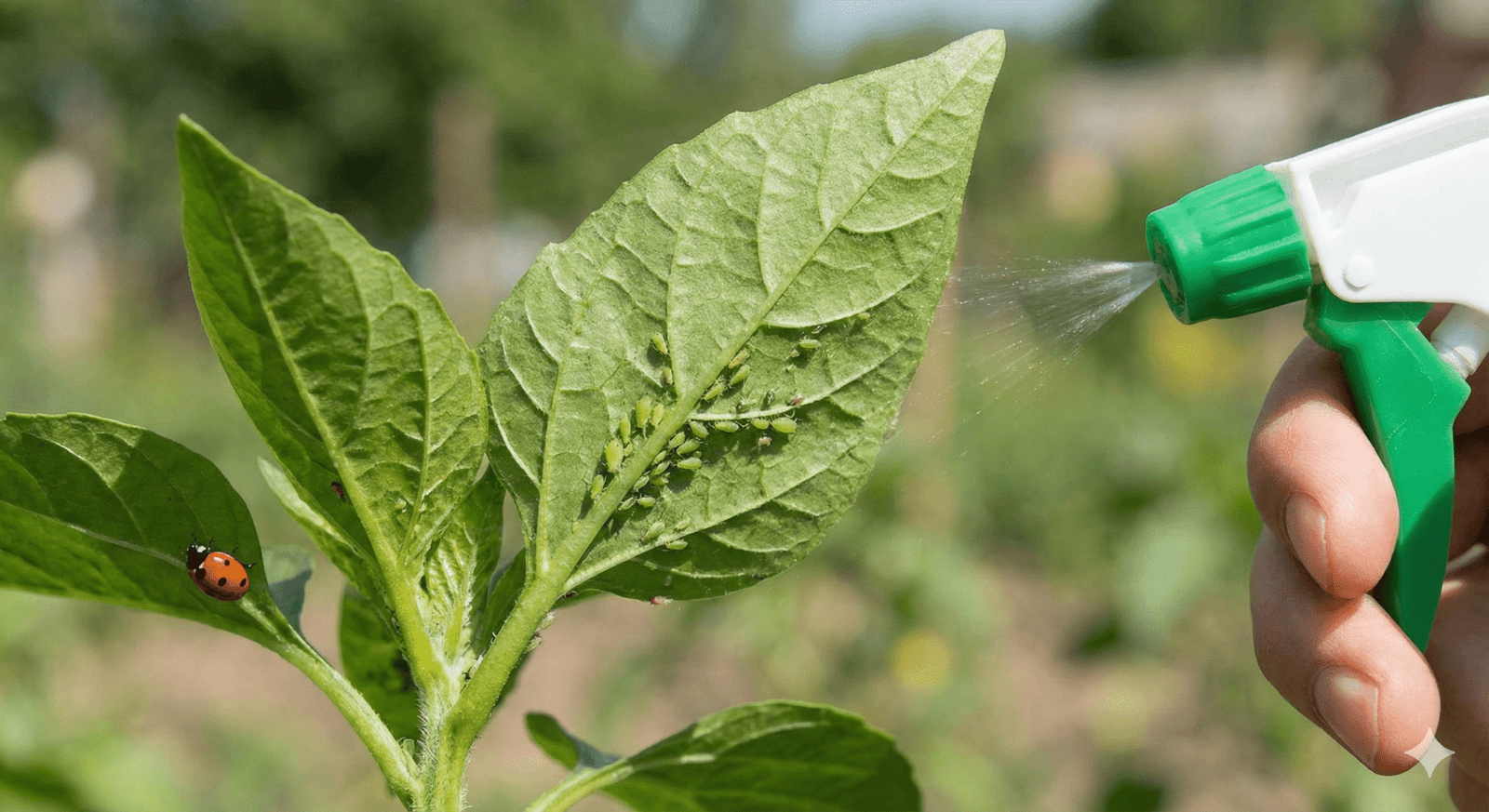
You sprayed your plants yesterday, but the aphids are back today. This failure is not because your insecticide was too weak; it is because you are fighting a biological anomaly.
Aphids possess a reproductive advantage called “telescoping generations.” In summer, females are born pregnant, reproducing asexually without the need for a mate. A single survivor can restart an entire colony within 24 hours. Consequently, the “spray once and wait” method guarantees failure.
To eradicate an infestation, you do not need stronger poison; you need a stricter schedule. This guide outlines a 14-Day Eradication Protocol designed to break the reproductive cycle, sever the symbiotic relationship with ants, and physically remove the pests without destroying your soil or harvest.
Step 0: The Ant Connection (Stop the Farming)
Before applying any treatment to the leaves, look at the stems. If you see ants marching up and down the plant, you are not just fighting a pest; you are fighting a farm.
Ants and aphids share a mutualistic relationship. Aphids excrete a sugary waste called “honeydew,” which ants consume as a primary food source. In exchange, ants act as bodyguards, aggressively attacking beneficial insects like ladybugs and lacewings that would naturally control the aphid population. Ants have even been observed carrying aphids to new plants to expand their farming operations.
The Protocol:
If ants are present, spraying the aphids is futile. The ants will recolonize the plant immediately.
- Create a Barrier: Apply a ring of Tanglefoot (a sticky, non-drying resin) or a band of masking tape covered in petroleum jelly around the main stem of the plant, about 2 inches from the soil line.
- Break the Bridge: Prune any low-hanging branches that touch the ground or adjacent structures, forcing ants to cross the sticky barrier.
- Bait the Colony: Place borax-based ant baits at the base of the plant to reduce the ant population at the source.
Identification: Know Your Enemy
Proper identification prevents the misuse of pesticides on harmless insects or the wrong treatment for specific pests. While there are thousands of aphid species, they fall into two tactical categories for the home gardener.
Green, Black, and Red Aphids (Standard)
These are the most common variants. They are soft-bodied, pear-shaped insects roughly 1/16th of an inch long. They possess two “tailpipes” (cornicles) on their rear.
- Location: They congregate in dense clusters on the undersides of leaves and growing tips (new shoots). They rarely inhabit old, tough foliage.
- Detection: Look for curled, yellowing leaves and a sticky sheen (honeydew) on the foliage below the infestation.
Woolly Aphids (The Exception)
Woolly aphids require a different approach. They secrete a white, waxy, cotton-like substance that covers their bodies.
- The Problem: This waxy shield repels water-based contact sprays (like insecticidal soap), allowing the insect inside to survive a standard treatment.
- The Adjustment: You must physically disrupt the colony first. Use a soft-bristled brush or a high-pressure stream of water to scour the “wool” off the plant before applying any treatment. If you do not remove the wax, the treatment will not contact the insect’s skin.
The “Safe Soap” Protocol: Detergent vs. Soap
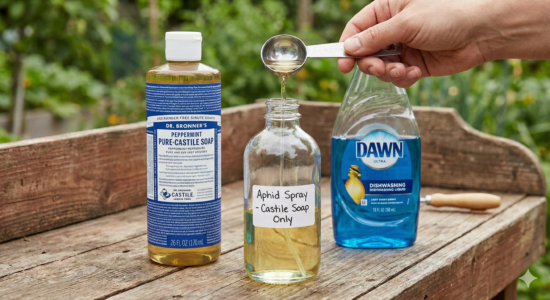
The internet is full of bad advice suggesting you spray your garden with dish detergent (like Dawn or Palmolive). Do not do this.
Modern dish detergents are “degreasers” designed to strip fat from ceramic plates. Plants have a protective wax layer on their leaves called the cuticle, which retains moisture. Detergents strip this cuticle, leading to leaf burn (phytotoxicity) and dehydration.
The Science of True Soap
You need Pure Castile Soap (e.g., Dr. Bronner’s). True soaps are made from fats (oils) and alkali. They work by penetrating the aphid’s soft outer shell and dissolving its cell membranes, causing it to dehydrate and die. They are gentle enough to leave the plant’s cuticle intact.
The Kitchen-Safe Recipe
- 1 Quart Warm Water
- 1 Teaspoon Pure Castile Soap (Peppermint or Unscented)
- 1/2 Teaspoon Vegetable Oil (Acts as a surfactant to help the mix stick to the bug)
Application Rule: Always spray in the early morning or late evening. Spraying soap in direct midday sun acts like a magnifying glass and will burn the leaves.
The 14-Day Spray Schedule (Breaking the Cycle)
Because aphids are born pregnant, killing the adults is only half the battle. You must catch the next generation before they reach reproductive maturity.
The 3-Day Rule:
- Day 1 (The Knockdown): Thoroughly spray the plant, focusing entirely on the undersides of the leaves.
- Day 4 (The Clean Up): Any nymphs that were shielded by their mothers’ bodies on Day 1 are now exposed. Spray again.
- Day 7 (The Insurance): A third wave may hatch from nearby colonizers. Spray again.
- Day 10 (Final Check): Inspect the plant. If you find even one aphid, repeat the cycle. If clear, switch to weekly monitoring.
Chemical & Biological Warfare Options
Sometimes, soap isn’t enough for a massive infestation.
Neem Oil for Aphids
Neem oil is a botanical insecticide that works two ways: it smothers the insect on contact and disrupts their hormonal system, causing them to forget to eat or reproduce.
- Warning: Neem oil is heavy. Do not use it on wilted, drought-stressed plants, or when temperatures exceed 90°F.
Biological Control: Ladybugs vs. Lacewings
- Ladybugs: While iconic, adult ladybugs are migratory. If you buy a bag of 1,500 ladybugs and release them, 90% will fly away within 24 hours.
- Green Lacewings: These are the superior predator. Their larvae (known as “Aphid Lions”) are flightless voracious eaters. Releasing lacewing eggs ensures the predators stay on your vegetable garden plants where the problem is.
The “Harvest Rescue”: Can I Still Eat the Kale?
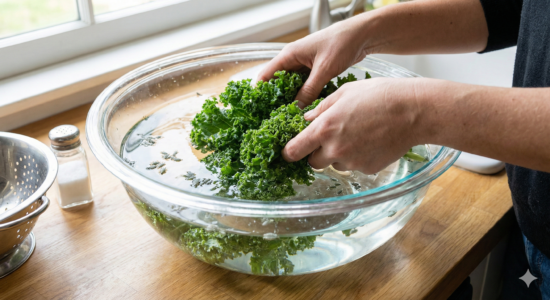
A common panic for new gardeners is finding their broccoli or kale covered in gray aphids. Yes, the harvest is safe to eat. Aphids do not transmit diseases to humans.
The Salt Water Soak:
- Fill a large bowl with cold water.
- Add 2 tablespoons of table salt.
- Submerge the vegetables (head down) for 10 minutes.
- The Result: The salt water causes the aphids to spasm, detach, and float to the surface. The dirt sinks to the bottom. Rinse the produce, and it is ready for the kitchen.
Troubleshooting & Prevention
Why do they keep coming back?
If you followed the 14-day protocol and they returned, check your fertilizer.
Aphids are attracted to high levels of free nitrogen in plant sap. Using rapid-release organic lawn fertilizer or heavy doses of blood meal creates “sappy” growth that acts as a beacon for pests. Switch to a slow-release compost or granular fertilizer to moderate growth speed.
Indoor Plant Hitchhikers
Aphids often enter homes on cut flowers or new nursery plants.
- The Quarantine Rule: Never put a new plant directly next to your established houseplants. Isolate it for 14 days and inspect the undersides of leaves for hitchhikers.
Conclusion: The 3-Step Eradication Checklist
Winning the war against aphids is not about luck; it is about persistence.
- Block the Ants: Apply Tanglefoot to stop the “farmers.”
- Spray the Schedule: Days 1, 4, 7, and 10 using Castile soap, not detergent.
- Check the Nitrogen: Stop over-fertilizing to make your plants less tasty.
Leave a Reply