
Most homeowners abandon organic lawn care within their first season. This is rarely due to product failure; it is an expectation failure caused by the “Synthetic Steroid” trap.
For decades, the industry has conditioned you to expect immediate gratification. Synthetic chemical fertilizers are highly water-soluble nitrates that bypass the soil ecosystem to force rapid, weak cell growth. This gives you a neon green lawn in 48 hours, but it acts like a sugar crash: it spikes growth, kills the beneficial soil microbiome through salt accumulation, and leaves your turf addicted to the next chemical injection.
Switching to organic is not a product swap; it is a soil engineering project.
True organic fertilizers—derived from feather meal, grain, or poultry waste—are insoluble. They do not feed the grass directly; they feed the microbes, which then process nutrients into a plant-available form. This guide ignores marketing fluff to focus on the physics of slow-release nutrition. We analyzed the top brands based on N-P-K ratios, ingredient purity (biosolids vs. protein), and particle breakdown rates to determine which products actually build a self-sustaining lawn.
Quick Comparison: Top 5 Organic Lawn Fertilizers
Here is the updated comparison table with the “Check Price” column added, using your specific affiliate links.
Quick Comparison: Top 5 Organic Lawn Fertilizers
| Brand Name | Best For | N-P-K Ratio | Coverage (Sq Ft) | Key Ingredient | Price |
| Espoma Organic Lawn Food | Overall Soil Health | 9-0-0 | 5,000 | Feather Meal & Bio-tone Microbes | Check Price on Amazon |
| Milorganite | Budget / Deep Green | 6-4-0 | 2,500 | Heat-Dried Biosolids (Recycled Waste) | Check Price on Amazon |
| Scott’s Natural Lawn Food | Availability & Ease | 11-2-2 | 4,000 | Meat & Bone Meal, Feather Meal | Check Price on Amazon |
| Jobe’s Organics | Root Development | 9-2-1 | 5,000 | Feather Meal & Archaea Microbes | Check Price on Amazon |
| Simple Lawn Solutions | Fast-Acting (Liquid) | 3-18-18 | 3,200 | Seaweed & Fish Emulsion | Check Price on Amazon |
The Top 5 Organic Fertilizers: In-Depth Reviews
1. The Engineer’s Choice: Espoma Organic Lawn Food (Best Overall)
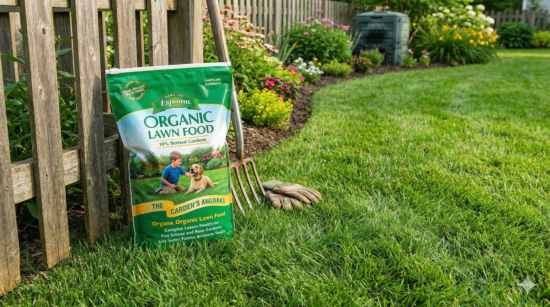
Review: Espoma Organic Lawn Food (The Engineer’s Choice)
Espoma is the gold standard for homeowners who want to engineer a self-sustaining ecosystem, not just grow grass. With an N-P-K of 9-0-0, it relies on feather meal and poultry manure to provide a consistent, slow-release nitrogen feed. Unlike synthetic nitrates that dissolve instantly and force rapid, weak growth (like a steroid shot), Espoma’s insoluble nitrogen must be broken down by soil microbes.
This bag includes Espoma’s proprietary Bio-tone® microbes—dormant bacteria that wake up to actively digest the fertilizer and aerate your soil biologically. This process lowers the salt index of your soil, preventing the “fertilizer burn” common with chemical brands, and encourages deep root mining. It builds a permanent soil structure that holds water better, rather than leaving your turf addicted to the next chemical fix.
Pros:
- Bio-tone Microbes: Includes live cultures to repair damaged soil biology.
- Safety: Safe for kids and pets immediately after application; no re-entry interval.
- Non-Burning: Zero salt index means you can’t accidentally kill your grass.
Cons:
- Cost: Significantly more expensive per square foot than Milorganite or Scott’s.
- Speed: Takes 2-3 weeks to see visual results during the first application.
The Verdict:
It is the absolute best option for families who prioritize safety and long-term soil health over immediate, cheap color.
Check Price & Availability for Espoma Organic Lawn Food on Amazon
If you want a strictly “clean” lawn that is safe for vegetable runoff and creates a self-sustaining ecosystem, Espoma is the gold standard.
- The Chemistry: Unlike cheaper options, Espoma relies on Feather Meal for its nitrogen. Feather meal is a slow-release protein that breaks down consistently without the “barnyard smell” of manure-based products.
- The “Secret Sauce”: It contains Espoma’s proprietary “Bio-tone” microbes. These are dormant bacteria and fungi that wake up upon watering to actively repair your soil biology.
- The Verdict: It is pricier per bag, but it builds the healthiest soil over a 3-year period.
2. The Budget King: Milorganite (Best for Color)
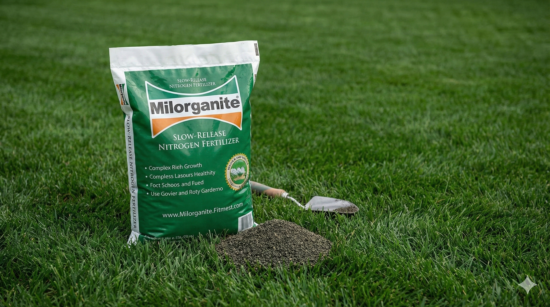
Review: Milorganite Slow-Release Nitrogen Fertilizer (The Budget King)
Milorganite is the “working man’s” organic fertilizer. Unlike boutique blends, this bag contains heat-dried biosolids (recycled microbial matter from wastewater treatment), delivering an N-P-K of 6-4-0. While the idea of biosolids might sound unappealing, the results are undeniable. The secret weapon isn’t the Nitrogen; it’s the 2.5% Iron content.
Synthetics force grass to grow tall and thin; Milorganite’s iron forces it to turn a deep, dark blue-green without the excessive surge in height. Because the nutrients are bound in organic matter, they must be broken down by soil microbes. This “spoon-feeding” mechanism eliminates the risk of fertilizer burn and leaching, allowing you to dump it down without worrying about rain washing your money into the storm drain. It creates a dense, rich turf that chokes out weeds naturally.
Pros:
- Iron-Rich: Delivers the darkest green color of any organic product on the list.
- Foolproof: Non-burning formula means you can’t mess it up, even if you over-apply.
- Cost-Effective: Typically the cheapest cost-per-pound of nitrogen in the organic category.
Cons:
- Smell: Has a distinct, earthy “barnyard” odor for 1-2 days after application.
- Biosolids: Not approved for organic vegetable certification (OMRI) due to heavy metal regulations, though safe for lawns.
The Verdict:
If you want the darkest green lawn on the block for the lowest price and don’t mind a temporary earthy smell, this is the undisputed king.
Check Price & Availability for Milorganite on Amazon
Milorganite is the industry giant for a reason: it works, and it is cheap.
- The Chemistry: Milorganite is made from heat-dried Biosolids (treated municipal wastewater). It contains a high amount of Iron (2.5%), which delivers a deep, dark blue-green color that most other organics cannot match.
- The Warning: Because it is a biosolid product, it is not recommended for use directly on vegetable gardens due to potential heavy metal concerns. It also has a distinct earthy smell for 24 hours after application.
- The Verdict: The best “bang for your buck” for ornamental lawns where deep color is the priority.
3. The Quick Fix: Simple Lawn Solutions 3-18-18 (Best Liquid)
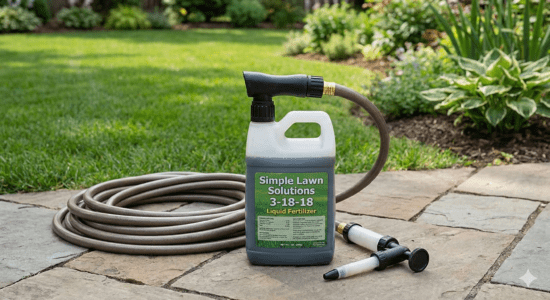
Simple Lawn Solutions 3-18-18 Liquid Fertilizer
This isn’t your standard nitrogen bomb. With an N-P-K ratio of 3-18-18, this liquid fertilizer prioritizes root expansion (Phosphorus) and stress resistance (Potassium) over generic top growth. Most homeowners make the mistake of nuking their yard with high-nitrogen synthetics, which act like salt on a slug to your soil microbes—dehydrating and killing the beneficial bacteria you need.
Simple Lawn Solutions flips the script by using organic bio-stimulants like seaweed and fish emulsion. These ingredients provide immediate foliar absorption to the grass blades while introducing carbon-based nutrition that supports, rather than destroys, your soil microbiome. It is a surgical tool for strengthening weak roots and helping grass survive heat stress, not a cheap chemical sugar rush.
Pros:
- Instant Absorption: Liquid formula enters the plant immediately through the leaves.
- High Phosphorus: Specifically targets root mass development, not just blade growth.
- Microbiome Safe: No high-salt synthetics to dehydrate soil bacteria.
Cons:
- Low Nitrogen: Will not give you the dark “Milorganite Green” color shift.
- Liquid: Does not add physical organic matter to the soil structure like granules do.
The Verdict:
It is the best “emergency room” product for lawns suffering from heat stress or poor root development, but it shouldn’t replace your regular nitrogen feedings.
Check Price & Availability for Simple Lawn Solutions on Amazon
Sometimes you don’t have time to wait for microbes. If you have a backyard BBQ in 3 days and the lawn looks sad, this is your tool.
- The Chemistry: This is a liquid concentrate high in Phosphorus and Potassium. Because it is applied as a spray, it can be absorbed foliarly (through the grass blades) rather than waiting for root uptake.
- The Trade-off: Liquids are a “snack,” not a meal. They provide a quick boost but do not build soil structure like granules do.
- The Verdict: Keep a bottle on hand for emergencies, but don’t use it as your primary feed.
4. The Transition Tool: Scott’s Natural Lawn Food
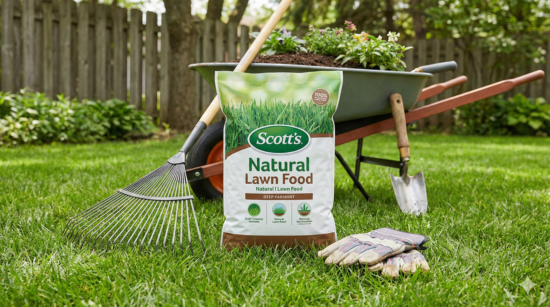
Review: Scott’s Natural Lawn Food (The Transition Tool)
If you are addicted to the “instant green” of chemical fertilizers but want to stop poisoning your soil, this is your methadone. With an impressive N-P-K of 11-2-2, Scott’s Natural delivers the highest nitrogen payload of any major organic brand. Derived from meat meal, bone meal, and feather meal, it mimics the rapid growth flush of a synthetic without the toxic salt index that dehydrates earthworms and microbes.
While synthetic ammonium nitrate bypasses the soil food web entirely, these protein-based ingredients must be digested by soil bacteria to release nutrients. This means you get the best of both worlds: the rapid greening you expect from the Scott’s brand, but with a mechanism that builds bacterial density rather than destroying it. It is the perfect “bridge product” for beginners.
Pros:
- High Nitrogen (11%): The fastest visual green-up of any organic granule.
- OMRI Listed: Verified organic, unlike many “natural-based” imposters.
- Availability: Easy to find, consistent particle size, and spreads reliably.
Cons:
- Attracts Pets: The bone/meat meal scent can trigger digging in dogs.
- Short Duration: Because it acts fast, it burns out faster (6 weeks) than slow-release feather meal.
The Verdict:
This is the only choice for impatient homeowners who demand synthetic-speed results while transitioning to a safe, organic regimen.
Check Price & Availability for Scott’s Natural Lawn Food on Amazon
For those moving away from the “4-Step Program,” this is the easiest entry point.
- The Chemistry: It boasts an N-P-K of 11-2-2, which is very high for an organic product. This means it pushes growth faster than Espoma or Milorganite, mimicking the speed of a synthetic.
- The Verdict: Excellent availability (you can find it at any hardware store) and consistent results make it a safe bet for beginners.
5. The Root Builder: Jobe’s Organics
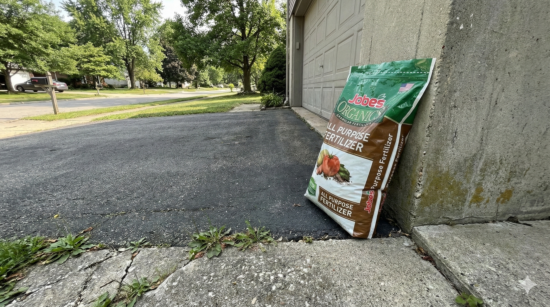
Jobe’s Organics isn’t just fertilizer; it’s a soil renovator. With an N-P-K of 9-2-1, it delivers a strong nitrogen kick derived from feather meal and poultry meal, intentionally avoiding the cheap synthetic nitrates that burn roots and leach into groundwater. Unlike sterile chemical pellets, this bag contains Jobe’s proprietary Biozome—a unique blend of Archaea, bacteria, and mycorrhizal fungi.
These aggressive microorganisms break down complex nutrients and thatch faster than standard organic fertilizers, essentially “pre-chewing” the food for your grass. While synthetic fertilizers spike soil salinity and kill beneficial life, Jobe’s builds a fungal network that improves drought tolerance and nutrient uptake naturally. It’s the difference between giving your lawn a sugar rush and a balanced, probiotic meal.
Pros:
- Biozome Technology: Archaea microbes actively break down thatch and poor soil.
- Feather Meal Base: Provides consistent, non-burning nitrogen.
- Complete Ecology: Adds fungi and bacteria to restore “dead” dirt.
Cons:
- Scent: The poultry meal base has a noticeable “farm” smell for about 24 hours.
- Dust: The granules are less uniform than synthetics, which can be slightly dusty during spreading.
The Verdict: This is the best choice for rehabilitating compacted or neglected soil that needs a microbial reboot alongside its nitrogen.
Check Price & Availability for Jobe’s Organics on Amazon
Best for new sod, patch repair, or compacted soil.
- The Chemistry: Jobe’s focuses on Biozome, a blend of Archaea (ancient microbes) that are aggressive at breaking down thatch and complex minerals.
- The Verdict: Use this if your soil is hard, compacted, or “dead.” The aggressive microbial package helps aerate the soil biologically.
The Horticultural Physics: Why “Feeding the Soil” isn’t a Metaphor
To understand why organic fertilizer outperforms synthetics long-term, we must look beyond the N-P-K label and examine the physics of soil interaction. The difference isn’t just about ingredients; it is about osmotic pressure and molecular adhesion.
1. The Salt Index & Osmotic Shock (The “Burn” Factor)
Synthetic fertilizers (like Ammonium Nitrate or Urea) are chemically classified as salts. In the soil, they behave exactly like table salt does in your body: they are hygroscopic, meaning they aggressively attract water.
- The Synthetic Mechanism: When you apply high-salt synthetics, they dissolve into the soil solution and raise the osmotic pressure. This creates a “reverse osmosis” effect where water is pulled out of the root cells and beneficial microbial bodies to balance the salt concentration.
- The Result: This dehydrates and kills the soil microbiome and causes “Fertilizer Burn.”
- The Organic Reality: Organic fertilizers have a negligible salt index. They do not dissolve in water; they must be biologically digested. Therefore, they create zero osmotic stress, allowing roots to remain hydrated even during drought.
2. Leaching vs. Mineralization
- Synthetic Leaching: A heavy rain pushes dissolved synthetic nitrates down through the soil profile faster than roots can absorb them. The nutrients bypass the plant and end up in the groundwater.
- Organic Mineralization: Organic nutrients are locked in complex molecules. They rely on mineralization—the process where microbes eat the fertilizer and excrete plant-available ammonium. This process is temperature-dependent. Microbes are more active in warm weather—exactly when grass grows fastest. This creates a self-regulating system where nutrient release matches the plant’s metabolic demand.
3. Flocculation: Building the “Soil Sponge”
The most overlooked benefit of organic fertilizer is flocculation—the process of gluing soil particles together. As microbes consume organic fertilizer, they excrete sticky polysaccharides like glomalin. These glues bind clay and sand particles into small clumps called “aggregates,” creating pore space. This turns your soil into a sponge that holds water, effectively “drought-proofing” your lawn.
FAQ: Top 5 Anxiety Questions
1. Is organic fertilizer safe for my dog and kids?
Yes. Unlike synthetic chemicals which often require a “Re-entry Interval” of 24–48 hours, most organic fertilizers (derived from feather meal or grain) are safe for foot traffic immediately after application. However, if using products with Bone/Blood meal, water it in immediately so your dog isn’t tempted to eat the “food” smelling granules.
2. Does organic fertilizer smell terrible?
It depends on the ingredients. Fertilizers based on Poultry Manure or Biosolids (like Milorganite) will have a distinct “earthy” scent for 24–48 hours. If smell is a dealbreaker, choose a Feather Meal (Espoma) or Soy-based organic fertilizer, which are virtually odorless.
3. How long does it take to see results?
Patience is required. Organic fertilizers rely on mineralization, which takes 14–21 days to show visible greening. The trade-off is that organic color lasts 8–10 weeks and doesn’t lead to a “growth crash.”
4. Will it burn my lawn if I apply too much?
It is nearly impossible to burn a lawn with granular organic fertilizer. Because organic matter has a low salt index and must be broken down biologically, the nutrients are released slowly at a rate the grass can handle, even if you overlap your spreader passes.
5. Will it attract pests?
This is a risk with fertilizers containing Blood Meal or Bone Meal, which smell like prey to dogs and raccoons. If you have wildlife issues, stick to Milorganite or Corn Gluten/Feather Meal blends, which are unappealing to scavengers.
Leave a Reply