
You carefully chose the perfect tomato variety. You watered it. You bought the expensive organic fertilizer. But weeks later, your plant is yellowing, stunted, and sad.
The culprit? It’s likely not your “black thumb”—it’s your soil pH.
If your soil pH is off, your plants literally cannot eat the nutrients you feed them. It’s like trying to drink a milkshake through a coffee stirrer; the food is there, but the plant can’t access it. This is called “Nutrient Lockout“.
The good news? You don’t need a fancy $50 digital meter or a lab coat to fix it. You can check your soil’s pulse right now using simple pantry staples. Here are two scientifically-backed ways to test your garden soil pH at home without a kit.
Quick Summary
To test soil pH without a kit, collect a soil sample from your garden. Place 2 tablespoons of soil in a bowl and add vinegar; if it fizzes, your soil is alkaline. In a separate bowl, mix soil with distilled water and add baking soda; if it fizzes, your soil is acidic. If neither reacts, your soil is neutral.
Important Accuracy Disclaimer: These DIY methods are qualitative, meaning they tell you if soil is acid or alkaline, but not the exact number (e.g., 6.5). For precision, consider a professional lab test later.
When is the Best Time to Test Soil pH?
The best time to test your soil is in the Fall or Early Spring before planting. Testing in Fall is ideal because it gives amendments like lime or sulfur all winter to break down and adjust the pH before you plant your tomatoes in spring.
Method 1: The “Fizz Test” (Vinegar & Baking Soda)
Best For: A quick “Yes/No” diagnosis. Use this to find out if your soil is definitely Acidic or definitely Alkaline.
What You Need
-
2 Clean glass jars or bowls
-
Distilled water (Crucial: Tap water minerals can skew results)
-
White vinegar
-
Baking soda
-
Your soil sample
Step 1: Get a Good Sample
Don’t just scoop dirt from the surface. Dig down about 4–6 inches (root level). Take a little soil from 3 different spots in your garden and mix them together. This gives you an “average” reading so one accidental rock doesn’t fool you. Remove any twigs, rocks, or bugs.
Step 2: Test for Alkalinity (High pH)
-
Put 2 tablespoons of your soil into a jar.
-
Add roughly ½ cup of white vinegar.
-
Watch closely.
-
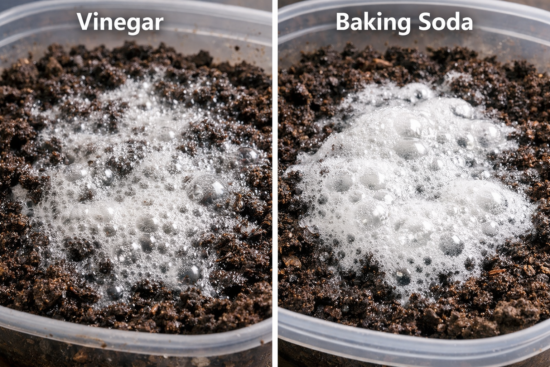
If it fizzes or bubbles: Your soil is Alkaline (pH > 7.0). The acid in the vinegar is reacting with the calcium carbonate in your soil.
-
If nothing happens: Move to Step 3.
-
Step 3: Test for Acidity (Low pH)
-
Put 2 tablespoons of fresh soil into a clean jar.
-
Add enough distilled water to make it sloppy and muddy.
-
Pour in ½ cup of baking soda.
-
Watch closely.
-
If it bubbles: Your soil is Acidic (pH < 7.0). The baking soda is reacting with the acidity in the soil.
-
If nothing happens: Congratulations! Your soil is Neutral (pH ~7.0). This is the “Goldilocks” zone for most vegetables.
-
Method 2: The “Cabbage Water” Test (The Color Chart)
Best For: Getting a slightly more precise reading than the Fizz Test (e.g., distinguishing between “kinda acidic” and “very acidic”).
What You Need
-
2 cups of Red Cabbage (chopped)
-
Distilled water
-
A pot for boiling
-
A strainer
-
A clear glass or jar
Instructions
-
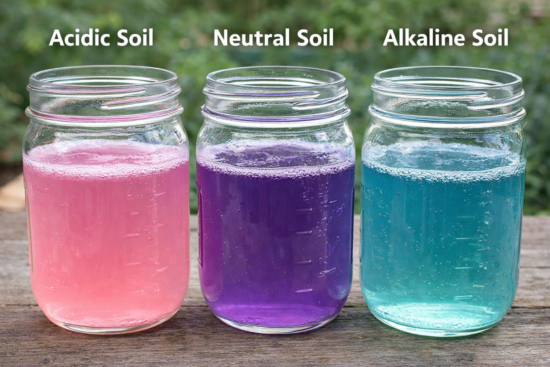
Make the Indicator: Boil the red cabbage in 2 cups of distilled water for 10–15 minutes. The water will turn a deep violet/blue color.
-
Strain: Strain out the cabbage chunks and pour the purple liquid into a clear jar. Let it cool completely. Since this water is neutral (pH 7), it is now your test canvas.
-
The Test: Add 2 spoonfuls of your garden soil to the jar and stir vigorously. Let it sit for 30 minutes until the dirt settles to the bottom.
Reading Your Results (Color Chart)
| Liquid Color | pH Level | Meaning | Best For |
|---|---|---|---|
| Red / Pink | Low (< 6.0) | Acidic | Blueberries, Azaleas, Potatoes |
| Purple / Violet | Neutral (6.0–7.0) | Neutral | Most Vegetables, Herbs |
| Blue / Green | High (> 7.5) | Alkaline | Asparagus, Lilacs, Thyme |
I Know My pH… Now What?
If Your Soil is Acidic (The “Sour” Soil)
- How to fix it: Add Garden Lime (Ground Limestone) or wood ash to raise the pH towards neutral.
If Your Soil is Alkaline (The “Sweet” Soil)
- How to fix it: Add Elemental Sulfur, pine needles, or peat moss to lower the pH.
If Your Soil is Neutral
Don’t touch the pH! Focus on adding organic matter like compost to keep it nutrient-rich and fluffy.
People Also Ask (FAQ)
Q: Is the vinegar soil test accurate? A: It is accurate for determining if soil is acidic or alkaline, but it cannot give you a specific pH number. Think of it as a compass, not a GPS.
Q: Can I use tap water for a soil test? A: No. Tap water often contains minerals (like calcium) that skew the pH, often making it appear more alkaline than it is. Always use distilled water.
Q: Can I use vinegar to lower my soil pH permanently? A: Vinegar (acetic acid) can lower soil pH, but the effect is very temporary and it can kill beneficial soil bacteria. For a long-term solution, Elemental Sulfur is much safer and more effective.
Ready to go deeper? Read our guide on Organic Gardening Soil 101or learn How to Improve Clay Soilif your results showed you have heavy dirt.
Leave a Reply