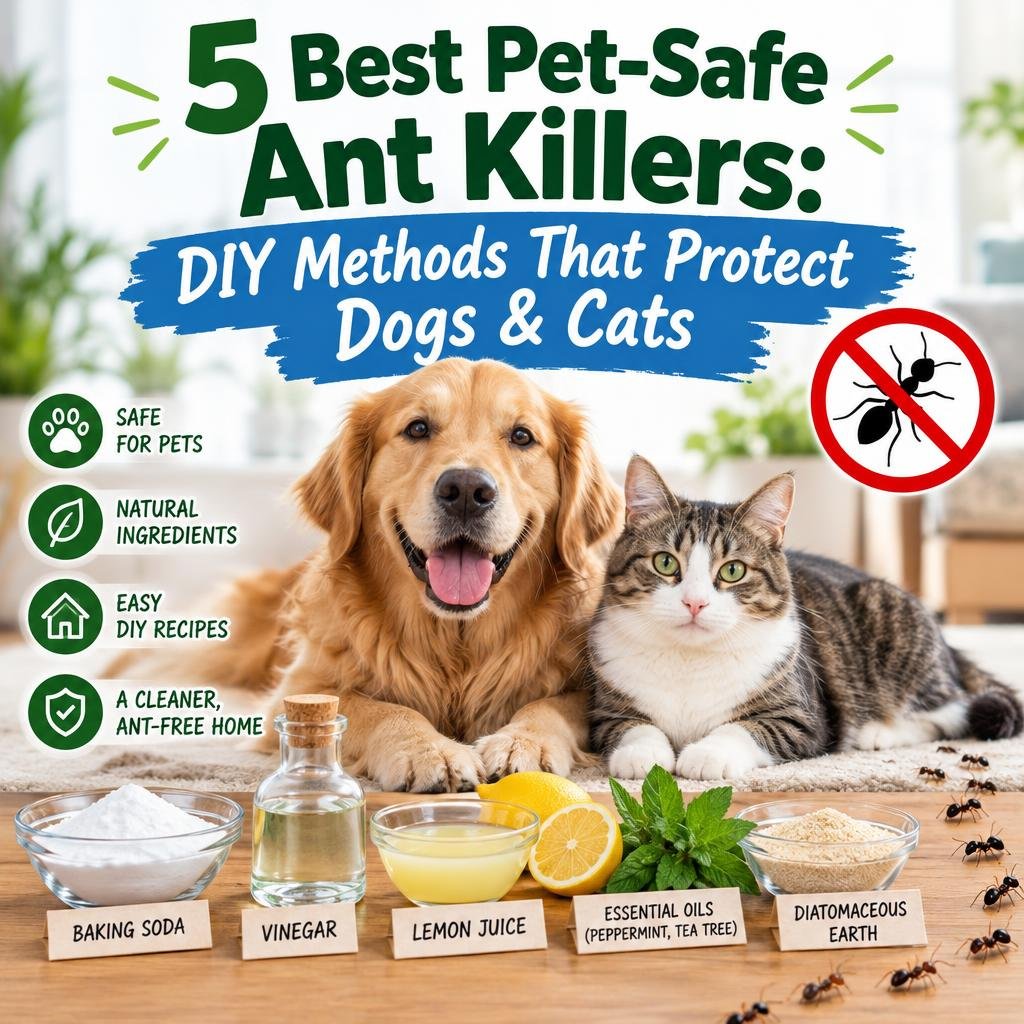
Finding a swarm of ants taking over your pet’s food bowl or trailing across kitchen and living room floors is a homeowner’s nightmare. However, grabbing a traditional chemical aerosol spray or placing open borax traps poses serious toxicity risks to curious dogs, cats, and puppies who explore the world with their noses and tongues.
Fortunately, you do not have to choose between a pest-free home and the health of your four-legged companions. By using food-grade, pet-safe compounds, you can eliminate foraging ants and protect your animals simultaneously.
For an overarching view of all organic recipes and colony eradication methods, start with our master guide on proven natural ant killer solutions.
Is Borax Actually Safe Around Pets?
While borax (sodium tetraborate) is an organic, naturally occurring mineral, it is not 100% pet-safe if left in open dishes. If ingested in moderate amounts, borax causes vomiting, diarrhea, lethargy, and stomach irritation in both dogs and cats.
If you choose to use borax because of its unmatched colony-killing power, you must house it inside tamper-proof bait stations that pets cannot open. You can see our exact protective build in our guide on how to make homemade borax ant traps safely.
If you want zero-risk solutions that can be applied directly on floors, carpets, and near pet bowls, use the five 100% pet-safe remedies below.
1. Baking Soda & Powdered Sugar (The Safest Ingestible Bait)
Baking soda (sodium bicarbonate) is completely safe in minor household quantities for dogs and cats, but it is fatal to ants. Because powdered sugar and baking soda have identical microscopic textures, ants cannot separate them and eagerly consume both.
Once ingested, the alkaline baking soda reacts with the acidic digestive fluids inside the ant, producing carbon dioxide gas. Because an ant’s digestive system cannot expel gas, it fatally ruptures their digestive tract within 24 to 48 hours.
The Safe Mix:
- 1 part pure baking soda
- 1 part confectioners’ powdered sugar (do not use granulated white sugar, as ants will simply separate and discard the baking soda crystals)
Place shallow bottle caps filled with this powder beneath refrigerators, behind pet feeding stations, or along baseboards.
2. Food-Grade Diatomaceous Earth (Mechanical Pest Barrier)
Food-Grade Diatomaceous Earth (DE) is made from finely pulverized, fossilized algae. It contains zero synthetic neurotoxins or chemical poisons. In fact, livestock farmers routinely blend it into animal feed to control internal parasites.
To crawling insects, however, DE is lethal. The microscopic silica crystals slice through an ant’s protective waxy coating, causing severe dehydration and death within hours of contact.
Safety Rule for Pet Owners: Ensure you buy strictly Food-Grade DE (never pool filter DE). Apply a very light, almost invisible dusting along door thresholds and skirting boards. Avoid creating large airborne dust clouds that could cause temporary sneezing or mild airway irritation in your dog or cat.
📋 Free Checklist: The Organic Home & Garden Pest Audit
Protecting your pets while keeping ants, fleas, and garden invaders out requires an organic system. Download our free printable checklist to safeguard your home naturally:
3. Distilled White Vinegar Surface Spray
Vinegar is completely non-toxic to dogs and cats. While pets may dislike the pungent smell, it is completely harmless if licked off floors.
Vinegar strips away the invisible pheromone scent highways laid down by ant scouts. Spraying an equal mix of white vinegar and water around pet bowls and entryways confuses worker columns and forces them to retreat.
4. Castile Soap & Water Knockdown Spray
If you see an active line of ants invading your pet’s feeding area, avoid synthetic bug sprays. Instead, mix 2 tablespoons of pure liquid Castile soap (such as Dr. Bronner’s baby unscented) into 1 quart of warm water.
Soap breaks down the waxy protective coating on an ant’s outer body, suffocating them within seconds without leaving harmful residues on your floor.
5. How to Create an Ant-Proof Pet Food Moat
Ants are drawn to the fats, proteins, and moisture found in dry kibble and canned pet food. You can permanently stop ants from entering your pet’s bowl using a simple water barrier:
- Place your pet’s food dish inside a slightly wider, shallow dish or baking pie pan.
- Fill the outer pan with half an inch of clean tap water (creating an island).
- Ants cannot cross water and will be physically blocked from ever reaching the kibble.
If ants are also nesting outside in your lawn or vegetable patches, see our guide on safe organic ant control for yards and gardens.
Frequently Asked Questions
Are essential oils safe to spray for ants around cats?
Caution is strongly advised. While peppermint and tea tree oils are popular DIY ant deterrents, they contain phenolic compounds that cats lack the liver enzymes to metabolize. If you have cats, stick strictly to baking soda, food-grade diatomaceous earth, and plain white vinegar sprays.
Will cinnamon hurt my dog?
Ceylon cinnamon is non-toxic to dogs and can act as a natural ant barrier due to its strong essential oils. However, avoid spreading excessive loose powder where dogs might sniff and inhale it directly into their nasal passages.
Written by Jennifer Reynolds
Certified Master Gardener • Sustainable Agriculture Specialist
Jennifer has over 15 years of hands-on experience in organic horticulture, permaculture soil biology, and non-toxic integrated pest management (IPM). Every recipe and garden strategy published on Organic Gardening Advise is field-tested in real raised beds to verify safety, dilution accuracy, and effectiveness. Learn more on our About Page.
Leave a Reply