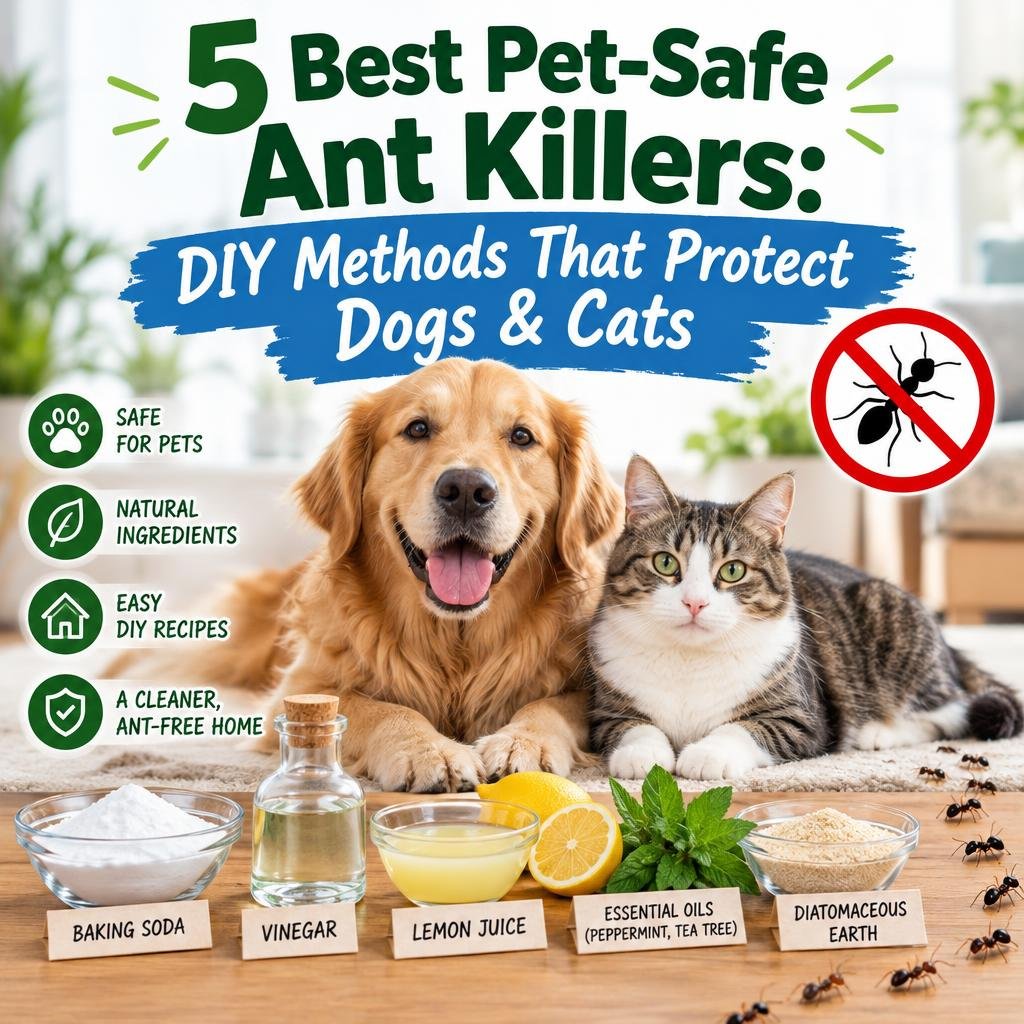
Disclosure: This post contains affiliate links. If you purchase through our links, we may earn an affiliate commission at no extra cost to you. As an Amazon Associate, we earn from qualifying purchases.
Finding an aggressive swarm of ants taking over your pet’s food bowl or trailing across kitchen and living room floors is every pet owner’s nightmare. However, grabbing a commercial aerosol spray can or setting out open bait traps poses severe, life-threatening toxicity hazards to curious dogs, cats, puppies, and kittens who explore the world nose-first and constantly groom their paws.
Traditional chemical insecticides contain neurotoxic pyrethroids (such as permethrin, bifenthrin, and cypermethrin) or fipronil that can induce tremors, seizures, and respiratory failure in pets—especially cats, who lack the glucuronidation liver enzymes necessary to process these synthetic compounds. Fortunately, you never have to choose between a pest-free home and the safety of your furry companions. In this veterinary-reviewed guide—part of our complete framework in The 7 Best Natural Ant Killers and our Plant-Safe Garden Ant Guide—we share proven, 100% pet-safe DIY ant remedies that destroy colonies without endangering your pets.
Pet-Safe Ant Remedy Comparison Matrix
Not all “natural” DIY remedies are safe for animals. Use this veterinary comparison matrix to select the right solution for your home:
| Remedy | Dog Safety | Cat Safety | Colony Elimination | Best Target Zone |
|---|---|---|---|---|
| Food-Grade Diatomaceous Earth | 100% Safe (Non-Toxic) | 100% Safe (Non-Toxic) | High (Mechanical barrier) | Doorways, baseboards, thresholds |
| Pure Castile Soap Spray | 100% Non-Toxic | 100% Non-Toxic | Instant contact knockdown | Live active foraging trails |
| Pet Food Bowl Water Moat | 100% Safe | 100% Safe | Immediate physical defense | Around dog & cat food bowls |
| Baking Soda & Powdered Sugar | Safe in small amounts | Safe in small amounts | Kills queen via ingestion | Behind appliances, out of reach |
| Distilled White Vinegar | 100% Safe | 100% Safe | Erases pheromone scent trails | Kitchen counters & tile floors |
| Essential Oils (Tea Tree / Citrus) | ⚠️ Mild Irritant | ⛔ LETHAL TO CATS | Repellent only | Avoid entirely if you own cats |
| Borax / Boric Acid Bait | ⚠️ Toxic if ingested | ⚠️ Toxic if ingested | 95%+ Colony elimination | Tamper-proof bait boxes only |
Veterinary Warning: Why Borax and Essential Oils Are Dangerous Around Pets
A common mistake online gardening and DIY blogs make is lumping Borax and essential oils into the “pet-safe” category simply because they are naturally derived. In veterinary toxicology, natural does not mean non-toxic:
- The Borax Hazard: Borax (sodium tetraborate) and boric acid are slow-acting stomach poisons. If a curious golden retriever or puppy laps up sweet borax sugar bait, the ingestion causes severe gastrointestinal ulceration, vomiting, diarrhea, and potential acute renal failure. Borax must never be used in open saucers in homes with free-roaming pets. If you need the heavy-hitting colony power of borax, you must enclose it inside locked, drill-holed plastic bait stations placed strictly out of pet reach, as detailed in our Borax Ant Killer Recipe.
- The Feline Essential Oil Hazard: Cats are physiologically deficient in cytochrome P450 and UDP-glucuronosyltransferase liver enzymes. Common essential oils recommended for ants—including tea tree, wintergreen, citrus (d-limonene), and peppermint—cannot be metabolized by felines. Even walking across sprayed floorboards and grooming their paws can cause liver failure and respiratory distress. If you own cats, stick strictly to the four zero-essential-oil remedies below.
Method #1: Food-Grade Diatomaceous Earth (The #1 Pet-Safe Barrier)
Certified Food-Grade Diatomaceous Earth (DE) consists of finely milled fossilized microscopic freshwater diatoms (amorphous silica). It is so chemically benign to mammals that organic livestock producers and veterinarians routinely mix it into animal feed to control internal parasites.
However, to crawling insects, DE is a microscopic death trap. The microscopic razor-sharp silica shards absorb the waxy outer lipid layer of an ant’s exoskeleton, causing the insect to dehydrate and die within 12 to 24 hours of contact. Ants cannot develop chemical resistance to physical mechanical desiccation.
🐾 Pet-Safe Essential Tool
Never use pool-grade diatomaceous earth, which contains toxic crystalline silica. Always select 100% food-grade amorphous silica bundled with a precision rubber bulb duster for pet-safe indoor application along baseboards and pet room thresholds.
Pro Application Rule for Pet Homes: Use your powder duster to apply an ultra-fine, nearly invisible film along baseboards, beneath kitchen cabinets, and behind appliances. Avoid squeezing heavy white clouds into the air that could irritate a pet’s nasal passages.
Method #2: Pure Liquid Castile Soap Knockdown Spray
When you see an active line of scout ants streaming toward your pet’s bowl, you need immediate knockdown without spraying synthetic aerosol poisons. The premier non-toxic solution is a spray made with pure liquid castile soap (such as Dr. Bronner’s Baby Unscented).
Unlike commercial dish soaps (Dawn, Palmolive) which contain synthetic sulfates, chemical surfactants, and artificial fragrances, pure castile soap is made exclusively from saponified organic plant oils (olive, coconut, jojoba). When sprayed on ants, the fatty acids dissolve the waxy cuticle and penetrate their respiratory spiracles, suffocating the ants within seconds while leaving zero toxic residue on your floors.
🐾 Pet-Safe Essential Tool
For homes with dogs and cats, use Dr. Bronner’s Baby Unscented Pure Liquid Castile Soap. It contains zero synthetic fragrances or essential oils, making it 100% safe to wipe down pet feeding areas while killing ants on contact.
The Recipe: Mix 2 tablespoons of pure liquid castile soap into 1 quart of warm water in a spray bottle. Spray directly onto active ant columns. Wipe clean with a paper towel. For full garden dilutions, see our dedicated Castile Soap Bug Spray Recipe.
Method #3: The Double-Bowl “Island Moat” Pet Feeder
Ants cannot resist the fats, animal proteins, and moisture in dry dog kibble and wet cat food. If ants are swarming your pet’s dish every morning, build an anti-gravity water moat in 60 seconds:
- Take a shallow baking cake pan, pie tin, or wide saucer with a 1-inch raised rim.
- Place your pet’s normal stainless steel or ceramic food dish right in the center of the shallow pan.
- Pour 1/2 inch of clean water into the outer pan, creating a 1-inch water ring completely surrounding the food dish.
- The Secret Pro Trick: Add one single drop of castile soap to the water moat. The soap breaks water surface tension, preventing tiny sugar ants from floating or walking across the surface! Ants are completely unable to reach the food.
Method #4: Baking Soda & Confectioners’ Sugar Queen Bait
If you need an ingestible bait that worker ants can carry back to feed the queen, but you cannot risk using toxic Borax, baking soda (sodium bicarbonate) is your safest organic alternative. In small quantities, baking soda is completely non-toxic to dogs and cats (it is frequently used to brush dog teeth!).
Because confectioners’ powdered sugar and baking soda have identical powdery particle sizes, foraging ants cannot separate them. They greedily consume the mixture and regurgitate it to the queen and larvae through trophallaxis. Inside the acidic digestive system of the ant, sodium bicarbonate produces carbon dioxide gas. Because ants cannot burp or expel gas, the expanding bubbles rupture their digestive tract, eliminating the colony safely within 24 to 48 hours.
The Exact Formula: Mix 1 tablespoon of pure baking soda with 1 tablespoon of confectioners’ powdered sugar (do not use granulated white sugar, as ants will simply pick out the sugar crystals and leave the baking soda). Place small bottle caps containing this powder behind the refrigerator, under stove kickplates, or inside closed cabinets where pets cannot reach.
Method #5: Distilled White Vinegar Scent Highway Eraser
Ants navigate through your home by following invisible chemical pheromone scent highways deposited by scouting worker ants. Even if you wipe away the visible ants, thousands of colony sisters will re-trace the same invisible trail within hours.
Distilled white vinegar contains acetic acid, which neutralizes and dissolves pheromone scent highways on contact. Mix equal parts white vinegar and water in a spray bottle and thoroughly mist kitchen countertops, baseboards, and window sills. While dogs and cats dislike the temporary sour smell, it is completely non-toxic and evaporates within 20 minutes.
4 Critical Mistakes Pet Owners Must Avoid
- Using Scented Aerosols in Pet Rooms: Commercial aerosol bug sprays leave microscopic chemical fallout on floors, rugs, and pet toys that pets lick and ingest.
- Placing Loose Powder on Carpets: Never dump thick mounds of diatomaceous earth or baking soda onto plush carpets where dogs or cats sleep. Use thin, invisible dustings confined strictly behind baseboards and appliances.
- Leaving Pet Food Out Overnight: Leaving moist canned food or open kibble bowls on the floor overnight invites nocturnal ant scouts. Transition to scheduled feeding times and pick up bowls within 30 minutes.
- Ignoring Outdoor Perimeter Mounds: If indoor ants persist, their master colony is almost always nesting in flowerbeds or lawn edges right against your home foundation. Treat exterior mounds using our Natural Fire Ant Mound Drenches or Carpenter Ant Solutions.
Download the Free Organic Pest Prevention Checklist & Spray Chart
Get instant access to our printable organic dilution cheat sheets, companion planting matrix, and seasonal pest calendar used by certified organic growers.
Frequently Asked Questions
Are ultrasonic ant repellers safe for dogs and cats?
While ultrasonic plug-in repellers do not emit chemicals, high-frequency sound waves can cause severe auditory stress, anxiety, and pacing in dogs and cats who hear in ultrasonic frequency ranges. Furthermore, entomological studies prove ultrasonic waves have zero long-term deterrent effect on ant colonies.
What should I do if my dog licks a baking soda ant trap?
In the small quantities used for ant traps (a few grams), baking soda will not cause toxicity in a healthy dog. Offer fresh drinking water to flush the salty taste. If an entire box of baking soda was consumed, contact your veterinarian immediately.
Written by Jennifer Reynolds
Certified Master Gardener • Sustainable Agriculture Specialist
Jennifer has over 15 years of hands-on experience in organic horticulture, permaculture soil biology, and non-toxic integrated pest management (IPM). Every recipe and garden strategy published on Organic Gardening Advise is field-tested in real raised beds to verify safety, dilution accuracy, and effectiveness. Learn more on our About Page.
Leave a Reply