Disclosure: This post contains affiliate links. If you purchase through our links, we may earn an affiliate commission at no extra cost to you. As an Amazon Associate, we earn from qualifying purchases.
If you have ever stepped into your summer vegetable garden to find your prize rose petals shredded, your green bean leaves reduced to lace-like skeletons, or your flourishing cucumber vines wilting into limp mush overnight, you are facing two of the most destructive beetle pests in North America: Japanese beetles and cucumber beetles.
While both belong to the order Coleoptera, they attack your garden in fundamentally different ways. Japanese beetles are ravenous defoliators that feed in swarms, chewing away leaf tissue between veins. Cucumber beetles, on the other hand, are vectors for a deadly, incurable plant pathogen known as bacterial wilt. A single cucumber beetle feeding on a seedling can transmit bacteria that plugs the plant’s vascular system, killing a mature squash or melon vine in less than 48 hours.
Chemical dusts like synthetic carbaryl (Sevin) may kill adult beetles on contact, but they also decimate honeybees, native bumblebees, and predatory assassin bugs, leaving your garden vulnerable to massive secondary outbreaks of spider mites and aphids. In this field guide—part of our complete framework in The Complete Guide to Organic Garden Pest Control—we break down tested, OMRI-listed organic strategies to eliminate both beetle species without harming your soil, pets, or pollinators.
Know Your Enemy: Japanese Beetles vs. Cucumber Beetles
Effective organic control begins with accurate identification. Below are the behavioral and physical markers of each pest:
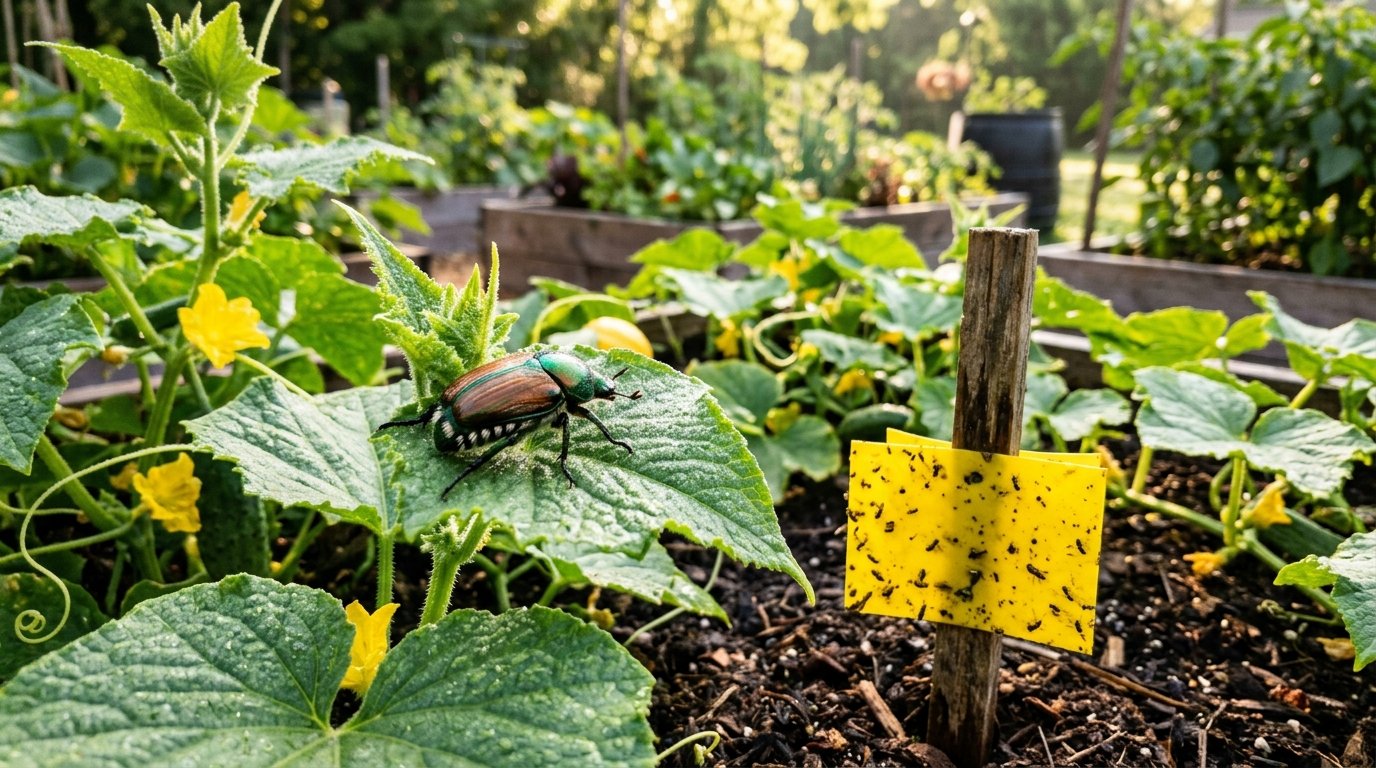
- Japanese Beetles (Popillia japonica): Measuring about 1/2 inch in length, Japanese beetles have metallic, iridescent green heads and copper-bronze wing covers (elytra). Their most definitive identifier is a series of five small white tufts of hair along each side of their abdomen, plus two tufts at the rear tip. They feed in dense clusters on sunny afternoons, targeting beans, corn tassels, raspberries, fruit trees, and over 300 ornamental species.
- Striped Cucumber Beetles (Acalymma vittatum): Approximately 1/4 inch long with a bright yellow-orange body and three distinct longitudinal black stripes running down their backs. They emerge from winter dormancy in early spring to attack emerging cucurbits (cucumbers, cantaloupes, winter squash, pumpkins, and watermelons).
- Spotted Cucumber Beetles (Diabrotica undecimpunctata): Also roughly 1/4 inch long, featuring a yellowish-green body adorned with exactly 12 black spots on their wing covers. Their larvae are known as southern corn rootworms, which feed aggressively on vegetable root crowns.
The Bacterial Wilt Threat: Why Cucumber Beetles Are Deadly
Unlike Japanese beetles whose feeding damage is largely cosmetic unless leaf loss exceeds 30%, cucumber beetles pose an existential threat to cucurbits because they harbor the bacterium Erwinia tracheiphila in their gut tracts.
When a beetle feeds on a tender leaf or stem, it deposits bacteria in its feces near the feeding wound. When dew or irrigation water washes the bacteria into the plant’s vascular tissue (xylem), the bacteria multiply exponentially, producing viscous extracellular slime that clogs water transport vessels. You will notice one runner suddenly go limp in the heat of the day, recover slightly at night, and then collapse entirely within 2 to 3 days. Once bacterial wilt infects a plant, there is no cure; the entire vine must be pulled and destroyed.
The Quick Sap Test for Bacterial Wilt: To confirm bacterial wilt, cut a wilting stem near the crown. Press the two cut ends together and slowly pull them apart about 1/2 inch. If a sticky, white viscous thread stretches between the two cut surfaces, bacterial wilt is confirmed.
The Pheromone Trap Paradox: Why Japanese Beetle Bags Can Backfire
Every spring, hardware stores display bright yellow Japanese beetle bags equipped with floral and sex pheromone lures. While these traps can catch thousands of beetles, university field trials consistently reveal a surprising truth: placing a pheromone trap in your garden actually increases beetle damage to nearby plants!
Pheromone lures are so potent that they attract beetles from up to a quarter-mile radius. However, only roughly 75% of the attracted beetles actually fall into the trap bag; the remaining 25% land on the nearest vegetables, fruit bushes, and roses to feed and mate. If you choose to use pheromone traps, never place them within 30 feet of your crops. Position them along outer property boundaries, downwind from your vegetable garden, to lure beetles away from your harvest.
Top 5 Organic Control Strategies for Garden Beetles
1. High-Efficiency Yellow Sticky Traps (Early Interception)
Cucumber beetles, flea beetles, and fungus gnats share an innate visual attraction to specific yellow wavelengths that mimic fresh, nutritious vegetative growth. By installing bright yellow sticky traps at plant height around cucumber mounds and squash borders, you capture the first wave of overwintering adult beetles in spring before they have a chance to feed and transmit bacterial wilt.
Unlike chemical sprays, sticky traps work 24/7 without contaminating edible fruit, washing away in rainstorms, or killing beneficial soil microbes. Check your traps twice weekly to monitor emerging pest populations.
Recommended Early Monitoring & Trapping
To intercept cucumber beetles, flea beetles, and winged garden pests before they infect your vegetable crops, we rely on weather-resistant Yellow Sticky Traps. Safe, non-toxic, and simple to stake directly around garden mounds.
2. Organic Protective Sprays: Kaolin Clay & Pure Neem Oil
When adult beetles land on vegetable leaves, they test the surface with sensitive sensory organs on their mouthparts and tarsi. You can stop feeding immediately using two proven organic repellents:
- Kaolin Clay Particle Film (Surround WP): An all-natural mineral clay that leaves a chalky white film over foliage. When beetles land on coated leaves, microscopic clay particles attach to their sensory receptors. Irritated and unable to taste plant sugars, the beetles leave immediately without taking a single bite. Kaolin clay also prevents sunburn on delicate tomatoes and squash!
- Cold-Pressed Neem Oil (Azadirachtin): As explained in our guide on how to mix neem oil for plants, azadirachtin acts as an anti-feedant and hormonal disruptor. Beetles that ingest treated foliage lose their appetite, cease mating, and fail to lay viable eggs.
To ensure even, full-canopy coverage without clogged nozzles, always mix your organic sprays in a reliable pump pressure sprayer with a brass extension wand.
Essential Spray Equipment
Applying kaolin clay, neem oil, or contact organic insecticidal soaps requires consistent pressure and atomized misting. We use the 1-Gallon Lawn & Garden Pump Pressure Sprayer with an adjustable brass wand for complete underside leaf protection.
Recommended Beetle Barrier: Surround WP Kaolin Clay
Surround WP is an OMRI-listed, all-natural kaolin clay particle film that coats vegetable leaves and fruit. When Japanese beetles and cucumber beetles land on treated leaves, the microscopic clay particles irritate their sensory receptors, stopping feeding and egg-laying immediately.
3. The Cold Morning Hand-Picking Bucket Routine
Beetles are cold-blooded ectotherms whose flight muscles require warmth to operate. Between 6:00 AM and 7:30 AM, when temperatures hover below 70°F (21°C), Japanese beetles are stiff, torpid, and physically unable to take flight.
Walk your garden with a wide-mouthed bucket filled with water and 2 tablespoons of liquid castile soap (from our DIY castile soap recipe). Hold the bucket directly beneath the beetle-infested branch and give the branch a firm tap. When threatened, Japanese beetles’ natural defense mechanism is to tuck their legs and drop straight down. They will fall directly into your soapy water bucket and drown within seconds. A 10-minute morning harvest can remove hundreds of breeding beetles daily!
4. Soil-Stage Biological Controls (Milky Spore & Nematodes)
Every adult Japanese beetle terrorizing your garden spent the preceding 10 months living underground in your lawn and garden soil as a white C-shaped grub. By targeting grubs in late summer and early autumn, you halt the lifecycle at its source:
- Milky Spore (Paenibacillus popilliae): A natural bacterium that specifically infects Japanese beetle grubs. When a grub swallows spores in the soil, the bacterium multiplies, turning the grub’s blood milky white and killing it. As the grub decomposes, it releases billions of fresh spores into the soil. A single thorough application of milky spore powder can establish natural biological suppression in your lawn for up to 10 to 15 years!
- Beneficial Nematodes (Heterorhabditis bacteriophora): Microscopic roundworms that actively seek out both Japanese beetle grubs and cucumber beetle larvae in the soil, entering through body openings and releasing symbiotic bacteria that eliminate grubs within 48 hours.
10-15 Year Grub Inoculation: Milky Spore Granular
To eliminate Japanese beetle grubs in lawn turf and garden soil permanently, apply OMRI-listed Milky Spore Granular. A natural bacterium (Paenibacillus popilliae) infects grubs in the soil, building biological protection that lasts up to 15 years.
5. Floating Row Covers: The Impenetrable Physical Barrier
Because cucumber beetles attack cotyledons and young seedlings during the first 3 to 4 weeks after germination, covering your crop beds with lightweight spun-bond polyester floating row covers provides 100% mechanical exclusion. Install hoops and secure the fabric edges with soil or metal landscape pins at planting time. Remember to remove the row covers once female blossoms appear to allow pollinating bees access to the flowers.
Organic Beetle Control Comparison Matrix
| Control Method | Target Pest | Pollinator Safety | Speed of Action | Application Window |
|---|---|---|---|---|
| Yellow Sticky Traps | Cucumber & flea beetles | 100% Safe (Non-toxic) | Immediate monitoring & catch | Spring emergence through harvest |
| Kaolin Clay Film | Japanese & cucumber beetles | 100% Safe (Mineral barrier) | Instant anti-feedant | Every 10–14 days or after heavy rains |
| Morning Bucket Hand-Picking | Japanese beetles | 100% Safe | Immediate elimination | 6:00 AM – 7:30 AM daily in midsummer |
| Milky Spore Powder | Japanese beetle grubs | 100% Safe (OMRI Listed) | Builds over 1–3 years | Late summer / early autumn lawn application |
| Floating Row Covers | Cucumber beetles | 100% Safe (Mechanical) | Immediate exclusion | Germination until initial blossom set |
| Synthetic Carbaryl (Sevin) | All insects | LETHAL TO BEES & BIRDS | Knockdown | Never recommended in organic gardens |
Action Plan: 7-Day Organic Beetle Eradication Protocol
- Day 1 – Install Yellow Sticky Traps: Mount yellow sticky traps on garden stakes at canopy height around your cucurbit beds and bean rows to identify beetle corridors.
- Day 2 – The Morning Hand-Pick Sweep: At 7:00 AM, tap sluggish Japanese beetles off your rose bushes, beans, and fruit trees directly into a bucket of soapy water.
- Day 3 – Inspect for Wilt Symptoms: Check cucumber and melon vines for flagging leaves. Immediately pull and bag any plant showing positive bacterial wilt symptoms to stop sap-feeding transmission.
- Day 4 – Apply Protective Kaolin or Neem Barrier: Fill your 1-gallon pump sprayer with kaolin clay or cold-pressed neem solution and coat all upper and lower leaf surfaces.
- Day 5 – Position Row Covers on Young Crops: Drape insect mesh over young seedlings and tuck edges tightly into soil.
- Day 6 – Check Outer Boundary Traps: If using pheromone bags, ensure they are positioned at least 30 to 50 feet away from your garden perimeter downwind.
- Day 7 – Plan Autumn Grub Inoculation: Inspect lawn turf around garden beds for soft, spongy grub damage. Order milky spore powder or beneficial nematodes for late summer soil application to wipe out next year’s beetle generation.
Frequently Asked Questions (FAQ)
Can cucumber plants recover once infected with bacterial wilt?
No. Bacterial wilt (Erwinia tracheiphila) multiplies inside the plant’s xylem vessels, physically blocking water uptake. Once systemic wilting begins, the plant cannot recover. Promptly pull and dispose of the entire plant in household trash—never compost wilted cucurbit vines.
Does companion planting deter Japanese beetles?
Yes. Planting garlic, chives, tansy, catnip, and rue around susceptible crops creates aromatic masking barriers that confuse beetle olfactory receptors. Additionally, white geraniums contain natural phytochemicals that temporarily paralyze Japanese beetles when ingested, making them easy targets for predatory birds.
How long do adult Japanese beetles remain active in gardens?
Adult Japanese beetles emerge from soil grubs in late June or early July (depending on your hardiness zone) and remain active for approximately 6 to 8 weeks. Peak swarm feeding occurs during hot, sunny afternoons in mid-July through early August before adults lay eggs in lawns and die off by early autumn.
Free Garden Pest Prevention Checklist
Download our free organic garden pest prevention checklist to protect your raised beds, tomatoes, cucurbits, and fruit crops all season long:
Written by Jennifer Reynolds
Certified Master Gardener • Sustainable Agriculture Specialist
Jennifer has over 15 years of hands-on experience in organic horticulture, permaculture soil biology, and non-toxic integrated pest management (IPM). Every recipe and garden strategy published on Organic Gardening Advise is field-tested in real raised beds to verify safety, dilution accuracy, and effectiveness. Learn more on our About Page.
Leave a Reply