Disclosure: This post contains affiliate links. If you purchase through our links, we may earn an affiliate commission at no extra cost to you. As an Amazon Associate, we earn from qualifying purchases.
Operating an unheated winter greenhouse, cold frame, or indoor grow tent allows dedicated organic gardeners to harvest fresh salads, brassicas, and hardy herbs while snow piles up outdoors. But enclosed winter growing environments create an invisible environmental paradox: cool daytime temperatures, shivering nighttime drops, limited airflow, and high humidity from transpired plant moisture. This microclimate is the ultimate incubator for Powdery Mildew (order Erysiphales).
Powdery mildew starts innocently as subtle, circular white talcum-powder spots on lower, shaded leaves of cucumbers, tomatoes, squash, rosemary, or winter lettuce. Within days, the fungal mycelium spreads across leaf surfaces, stems, and buds like a ghost shroud, blocking light, curling foliage, and triggering premature leaf drop. Left unmanaged, powdery mildew will ravage an entire enclosed crop canopy in under two weeks.
Fortunately, you don’t need synthetic systemic fungicides to protect your winter crops. Master Gardener Jennifer Reynolds outlines the proven organic prevention protocols, environmental VPD targets, and homemade potassium bicarbonate recipes to keep your winter grow spaces mildew-free.
Free Organic Pest Prevention Checklist & Spray Chart
Download our printable quick-reference spray schedule and kitchen-cabinet organic remedy guide to protect your garden all season long.
🔒 100% Privacy. Instant PDF Download. No spam ever.
The Winter Microclimate Paradox: How Powdery Mildew Thrives
Unlike many fungal diseases (such as downy mildew and black rot) that require standing water droplets on leaves to germinate, powdery mildew fungal spores (conidia) are biologically adapted to germinate in high relative humidity (70%+) without needing free liquid water. In fact, heavy direct rainfall or overhead water sprays actually wash powdery mildew spores away and inhibit germination.
In winter greenhouses and grow tents, three environmental triggers collide:
- Stagnant Micro-Layers: Without vigorous mechanical air movement, a dense boundary layer of still, humid air clings to the surface of dense foliage.
- Extreme Nighttime RH Spikes: As temperatures drop sharply after sunset, cold air loses its capacity to hold water vapor. Relative humidity surges to 85% to 95%, triggering explosive spore germination.
- Low Light Intensity: Short winter days and low solar angles weaken plant cell walls and reduce natural ultraviolet light, which normally suppresses fungal spore viability.
Environmental Control: Vapor Pressure Deficit (VPD) & Airflow
The first line of defense in organic mildew prevention is environmental management rather than foliar sprays. Adjust your winter growing space with these non-negotiable rules:
- Continuous 24/7 Air Circulation: Install oscillating fans positioned both above the plant canopy and at soil level. Air must gently rustle every leaf in the space, eliminating stagnant microclimates where humidity pools.
- Plant Spacing & Pruning: Never pack containers shoulder-to-shoulder in winter. Maintain at least 6 to 8 inches of clear space between pots. Prune away crowded lower interior suckers and senescent foliage to promote maximum light penetration and airflow.
- Morning Watering Only: Never water winter greenhouse beds or grow tents late in the afternoon. Water strictly in the morning so surface moisture evaporates before nighttime heating drops.
Organic Foliar Sprays: Prevention & Knockdown
1. Pure Potassium Bicarbonate Spray (The Gold Standard)
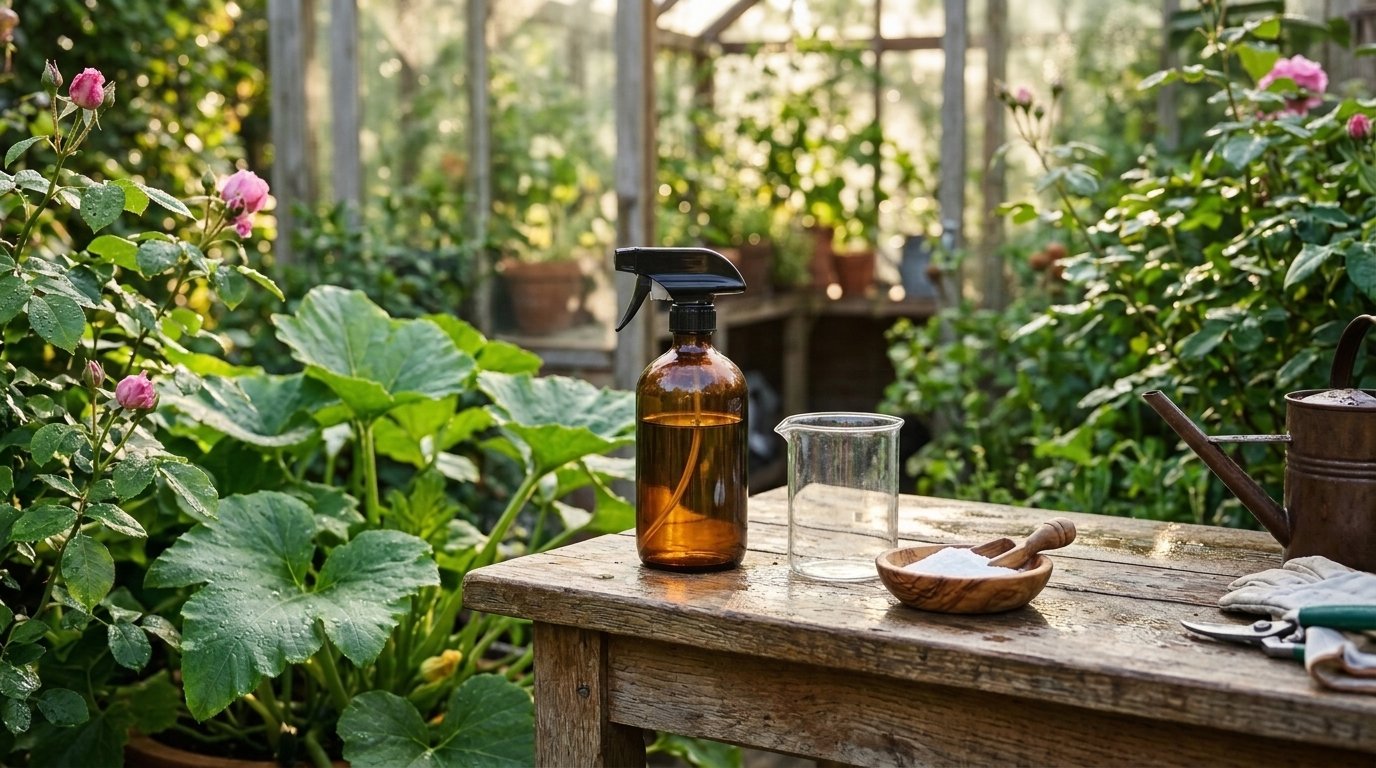
While ordinary sodium bicarbonate (baking soda) is a classic home remedy, Potassium Bicarbonate is five times more effective against active powdery mildew and provides beneficial potassium nourishment to plant roots without depositing toxic sodium into the soil. Potassium bicarbonate rapidly shifts the leaf surface pH to an alkaline 8.0 to 8.5, instantaneously rupturing fungal cell walls and collapsing mycelial threads.
The Master Organic Potassium Bicarbonate Recipe:
- 1 Tablespoon Pure Potassium Bicarbonate Fungicide on Amazon →
- 1/2 Teaspoon Dr. Bronner’s Liquid Castile Soap on Amazon → (essential wetting agent/spreader)
- 1 Gallon clean filtered water
Combine thoroughly in a 1-Gallon Pump Sprayer on Amazon →. Spray thoroughly across all foliage surfaces, focusing intensely on lower and interior leaves. Apply every 7 to 10 days preventatively, or every 4 days if active mildew spots appear.
2. The Organic Milk & Whey Protocol (Solar-Activated Protection)
Extensive university field research has confirmed that a 10% to 20% solution of raw milk or organic whey is as effective as synthetic fungicides against powdery mildew. When exposed to light (sunlight or full-spectrum grow lights), proteins in milk (particularly lactoferrin) produce free oxygen radicals that are toxic to fungal spores.
Recipe: Mix 1 part organic whole milk or whey with 9 parts water. Spray during the morning under active grow lights or sunshine. (Note: Only use in well-ventilated spaces with good airflow to prevent sour milk aromas).
3. Horticultural Oil Barrier Spray
Lightweight OMRI-listed horticultural mineral oils or cold-pressed neem oil provide an impermeable film that smothers spore germ tubes. For winter greenhouse maintenance, apply a 1% dilution of Pure Cold-Pressed Neem Oil on Amazon → combined with Castile soap every 14 days.
Winter Powdery Mildew Prevention Calendar
| Frequency | Action Item | Expected Benefit |
|---|---|---|
| Daily (Morning) | Inspect lower foliage & check RH hygrometer | Catches initial spots before spore dispersal |
| Continuous (24/7) | Run oscillating fans above and below canopy | Eliminates humid boundary microclimates |
| Every 7 to 10 Days | Preventative Potassium Bicarbonate foliar mist | Maintains alkaline surface pH hostile to spores |
| Bi-Weekly | Prune crowded inner stems and senescent leaves | Maximizes airflow and light penetration |
Tired of Pests Moving from Your Garden Into Your Home?
Get Jennifer Reynolds’ complete 6-part digital blueprint: The Complete Home Defense Bundle. Includes field-tested eradication protocols for ants, cockroaches, bed bugs, spiders, and rodents, plus a 16-page non-toxic recipe book.
Conclusion
Powdery mildew is completely preventable when you master your winter growing environment. By combining strong continuous air circulation, proper plant spacing, morning watering, and preventative potassium bicarbonate foliar sprays, you can enjoy thriving, vibrant green harvests all winter long.
Leave a Reply