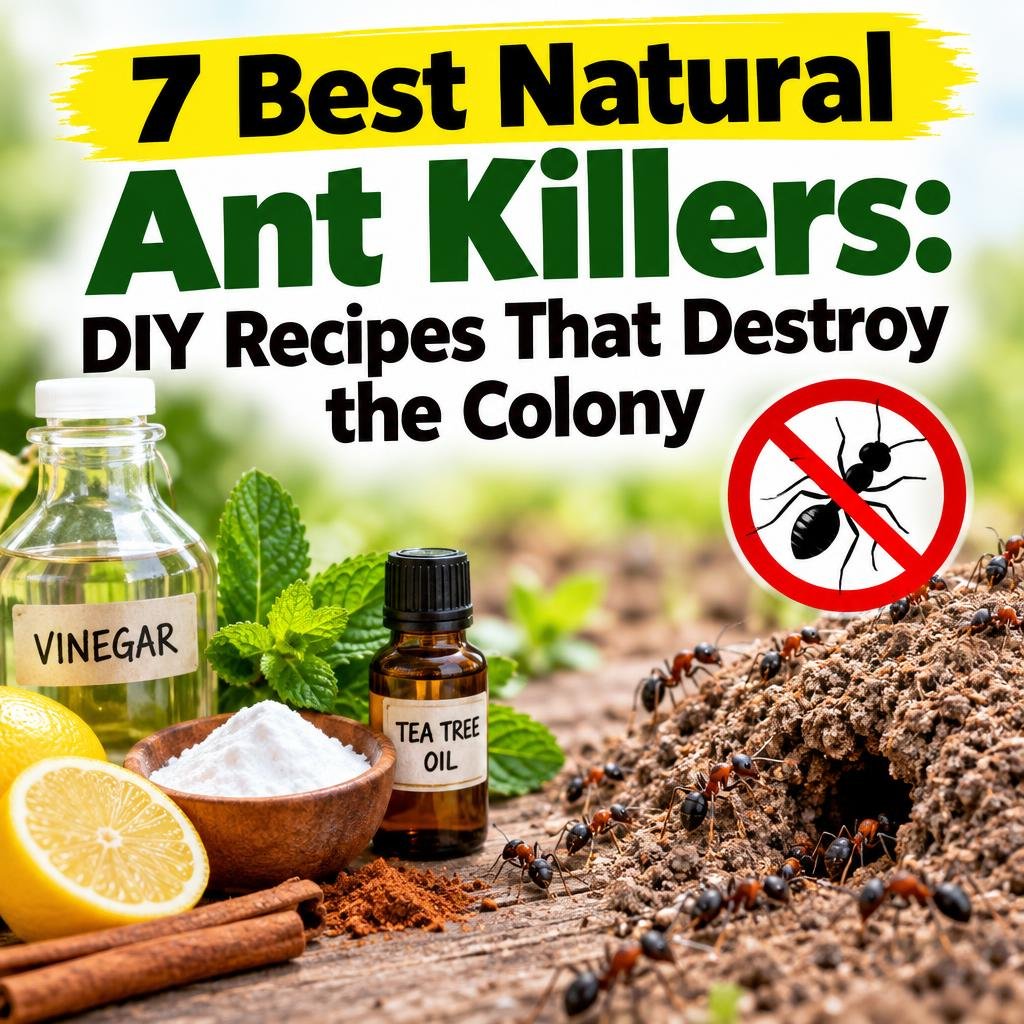
Finding a persistent line of ants marching across your kitchen counter, greenhouse benches, or raised garden beds is an immediate headache. While chemical sprays offer a quick knockdown, they coat your living spaces in toxic residue and only kill the scouts you see—leaving the hidden nest and egg-laying queen completely unharmed.
To truly eliminate an infestation without contaminating your home or organic garden soil, you need a natural ant killer that worker ants carry back to the colony to eradicate the source.
Below are 7 proven, organic-approved natural ant killer recipes using common household ingredients, complete with safety precautions and deployment instructions.
The Golden Rule: Repellents vs. Killers
Before mixing ingredients, it is critical to distinguish between these two approaches:
- Natural Repellents: (e.g., peppermint, cinnamon, citrus peels) repel ants and break scent trails. They do not eliminate the nest.
- Natural Killers: (e.g., borax, baking soda, diatomaceous earth) are ingested or physically destroy the exoskeleton, eradicating the entire colony.
Are Ants Guarding Pests on Your Plants?
If you notice ants marching up and down your tomato, pepper, or rose stems, they aren’t just scavenging—they are farming sap-sucking insects. Read our step-by-step guide on how to stop ants farming aphids in your garden to break the ant-bodyguard connection in 72 hours.
1. The Borax & Sugar Bait (The #1 Colony Killer)
Borax (sodium tetraborate) is a naturally occurring mineral that acts as a slow-acting stomach poison to ants. Because it does not kill immediately, foraging worker ants have ample time (24–48 hours) to transport the bait deep into the nest and feed it to the queen and larvae.
The Quick Recipe:
- 1/2 cup warm water
- 1/2 cup granulated white sugar (the attractant)
- 1.5 tablespoons Borax powder
Step-by-Step Instructions:
- Stir the sugar and borax into warm water until fully dissolved.
- Soak cotton balls in the mixture and set them inside small bottle caps, jar lids, or puncture-topped plastic containers.
- Place the bait stations directly along active ant trails near entry cracks, baseboards, or patio thresholds.
📌 Looking for exact ratios and pet-proof setups? Read our full guide on how to make borax ant killer bait and traps.
⚠️ Why DIY Ant Baits Fail (And How to Fix It)
If you’ve ever set out a homemade trap only to watch ants ignore it or die within inches of the dish, you likely hit one of these three common traps:
| The Problem | Why It Happens | The 60-Second Fix |
|---|---|---|
| Ants ignore the sugar water completely | The colony is currently in a protein/fat cycle for egg production rather than seeking carbohydrates. | Swap the sugar for creamy peanut butter or bacon grease mixed with 1/2 tsp of borax. |
| Ants die immediately at the bait station | Your borax concentration is too high (over 5%). Workers must survive long enough to regurgitate food to the queen. | Dilute your mixture with more warm water and sugar. The goal is slow toxicity over 24–48 hours. |
| More ants appear on Day 1 | This is normal! Scouts recruit nestmates via pheromones once they locate rich bait. | Do not squish or spray them. Let them feed freely so maximum poison returns to the underground chambers. |
📅 What to Expect: The Natural Eradication Timeline
- Hours 1 – 12: Scout recruitment. Ant activity around bait will increase dramatically.
- Hours 24 – 48: Bait dissemination. Trophallaxis occurs (ants share the poisoned bait with the queen and developing larvae).
- Days 3 – 5: Colony collapse. Visible trails drop by 80% to 90% as the queen ceases laying eggs.
- Day 7: Full eradication. Wipe away lingering trails with a 50/50 white vinegar spray to erase old paths permanently.
2. Baking Soda & Powdered Sugar (The Pet-Friendly Alternative)
If you have curious pets or small children and prefer avoiding borax entirely, baking soda is your safest bet. Ants cannot tell the difference between powdered sugar and baking soda because both have an identical grain texture.
Once ingested, baking soda reacts with the acidic digestive fluids inside the ant, producing carbon dioxide gas. Because an ant’s digestive system cannot expel gas, it safely and effectively neutralizes them.
The Recipe:
- 1 part baking soda
- 1 part confectioners’ powdered sugar (avoid granulated sugar, as ants will simply separate and discard the baking soda)
Mix thoroughly and place shallow spoonfuls in shallow lids near ant trails, pantry corners, and kitchen floorboards.
📌 Concerned about pets? Read our complete breakdown of 100% pet-safe ant killers for homes with dogs and cats.
3. Food-Grade Diatomaceous Earth (Best for Entry Points & Cracks)
Food-Grade Diatomaceous Earth (DE) is made from finely pulverized, fossilized aquatic organisms called diatoms. It is an OMRI-listed, natural control method prized by organic gardeners worldwide.
Rather than acting chemically, DE operates mechanically. Under a microscope, each particle has razor-sharp silica edges that absorb the oily protective layer of an ant’s exoskeleton, causing rapid dehydration and death within 12 to 24 hours.
Application Tips:
- Surfaces must be completely dry (moisture renders DE temporarily ineffective).
- Use a handheld bulb duster to apply a barely visible dusting along window frames, baseboards, exterior doorways, and raised bed borders.
- Always verify the label states Food-Grade (never use pool-grade diatomaceous earth, as it poses respiratory risks).
📌 Want step-by-step application tips and the wet-spray trick? Read our full guide on how to use food-grade diatomaceous earth for ants.
4. White Vinegar Spray (Instant Trail Disruptor)
Ants rely on invisible chemical pheromone trails to communicate and lead thousands of nestmates straight to food sources. White vinegar erases these trails instantly.
While an undiluted vinegar spray will kill individual ants upon contact, its true superpower is disorientation: it cuts off scout trails and prevents foraging columns from re-entering your living spaces.
- Formula: 50% distilled white vinegar + 50% clean water.
- Boost with essential oils: Add 10 drops of peppermint, tea tree, or citrus oil for extra scent-masking power.
- Spray thoroughly along countertops, threshold edges, windowsills, and trash can perimeters.
📌 Want the full recipe and surface safety guide? Check out our complete guide on how to make DIY vinegar ant spray.
5. Boiling Water & Dish Soap (For Outdoor Mounds)
If ant mounds are erupting along pathways, patio pavers, or lawn edges, you do not need toxic synthetic drenches to eliminate them.
The Method:
- Bring 2 to 3 gallons of water to a rolling boil.
- Stir in 2 tablespoons of organic liquid castile soap or biodegradable dish soap (soap lowers the surface tension, allowing the hot water to saturate deep into underground chambers).
- Slowly pour the boiling solution directly into the center of the mound to eradicate the queen.
📌 Dealing with aggressive imported red fire ants? While basic boiling water works on small nests, larger colonies require specialized liquid treatments. Read our dedicated guide on Natural Fire Ant Killer: Safe DIY Mound Drenches That Work for advanced citrus and organic drench recipes.
6. Cornmeal / Polenta
Cornmeal is a completely non-toxic solution safe for vegetable gardens, kitchen pantries, and animal enclosures. Foraging ants take dry cornmeal back to the nest to feed the larvae. Because ants cannot easily digest coarse grains, it disrupts food reserves inside the nest, causing the colony to starve or abandon the site.
Looking for the Exact Bait Formula?
If you make ant bait too strong, worker ants die before reaching the nest. If you make it too weak, the queen survives. Read our complete guide to the borax ant killer recipe with exact ratios to wipe out underground colonies within 48 to 72 hours.
7. Managing Persistent Carpenter Ants Naturally
If you notice large black ants accompanied by small piles of wood shavings (frass), you are likely facing carpenter ants. Unlike regular house ants, carpenter ants excavate galleries inside damp wood structures and typically prefer protein- or grease-based baits rather than simple sugar.
📌 Concerned about structural wood damage? Read our targeted guide on how to get rid of carpenter ants naturally using non-toxic protein baits and boric acid wall injections.
How to Prevent Future Ant Invasions
Eliminating the current colony is only half the battle. Implement these preventive organic practices to ensure they stay gone:
- Seal Foundation Gaps: Inspect exterior walls and apply silicone caulk around plumbing penetrations, cable entries, and door jambs.
- Store Food in Airtight Containers: Transfer grains, sugars, dried fruits, and pet food into airtight glass or heavy-duty plastic containers.
- Control Aphids in Your Garden: Ants frequently invade garden beds to “farm” sap-sucking aphids for sweet honeydew. Managing aphids with neem oil or ladybugs removes their primary outdoor food supply.
Frequently Asked Questions
What kills ants naturally, fast?
For instant contact knockdown, a 50/50 mixture of white vinegar and water or soapy water kills ants on contact. To destroy the entire underground nest, a liquid borax and sugar bait typically eradicates the queen and colony within 48 to 72 hours.
Does table salt kill ants?
Sprinkling dry table salt will not kill an ant colony. While boiling concentrated salt water can kill surface ants, it will damage your garden soil chemistry and is far less effective than diatomaceous earth or borax baits.
What is the best natural ant killer for kitchen counters?
In food preparation areas, use a two-pronged approach: wipe counters clean with a 50/50 white vinegar and water spray to erase scout trails, and place 1:1 baking soda and powdered sugar bait traps behind appliances.
📋 Free Checklist: Keep Pests Out of Your Home & Garden Naturally
Mixing baits is only part of the solution. Grab our free printable checklist to audit your foundation, seal entry points, and pest-proof your garden beds organically:
📌 Dealing with aggressive imported red fire ants? While basic boiling water works on small nests, larger colonies require specialized liquid treatments. Read our dedicated guide on Natural Fire Ant Killer: Safe DIY Mound Drenches That Work for advanced citrus and organic drench recipes.
Written by Jennifer Reynolds
Certified Master Gardener • Sustainable Agriculture Specialist
Jennifer has over 15 years of hands-on experience in organic horticulture, permaculture soil biology, and non-toxic integrated pest management (IPM). Every recipe and garden strategy published on Organic Gardening Advise is field-tested in real raised beds to verify safety, dilution accuracy, and effectiveness. Learn more on our About Page.
Leave a Reply