Disclosure: This post contains affiliate links. If you purchase through our links, we may earn an affiliate commission at no extra cost to you. As an Amazon Associate, we earn from qualifying purchases.
If you have ever sprayed your tomatoes, roses, or fruit trees for aphids, only to find twice as many back on the stems three days later, you are fighting the wrong enemy.
You do not just have an aphid infestation. You have an organized underground farming operation run by ants.
In the insect kingdom, ants act as personal bodyguards and shepherds for aphids. In exchange for the sticky, sugar-rich liquid aphids excrete (called honeydew), ants will:
- Aggressively attack and kill beneficial predators like ladybugs and lacewings.
- Carry aphid nymphs to tender new shoots to maximize feeding.
- Shelter aphids in underground nests during heavy rain or cold nights, re-introducing them to your prized plants the moment the sun comes out.
Here is the truth that generic gardening websites fail to mention: Spraying aphids while ants patrol the plant fails 100% of the time.
To save your garden, you must execute a coordinated, two-front organic offensive. Follow our proven 72-Hour Eradication Protocol below.
What they Won’t Tell You
Most general advice online recommends two things: “Smear Tanglefoot on the stems” and “Spray with neem oil”. If you do that on garden vegetables, you risk destroying your plants. Here are the 4 critical mistakes to avoid:
- The Stem Girdling Hazard: Sticky barriers like Tanglefoot are designed for mature tree bark. Applying sticky glue directly to tender green stems (like tomatoes, eggplants, or peppers) will cause chemical burns, restrict vascular growth, and snap the plant.
- The Rain-Wash Bait Trap: Outdoor borax bait stations without overhead rain covers get diluted during rainstorms, leaching toxic boron levels directly into your vegetable bed soil.
- The Daylight Ladybug Blunder: If you purchase commercial ladybugs and release them at noon in dry heat, over 90% fly off immediately into your neighbor’s yard without consuming a single aphid.
- The Pheromone Trail Ghost: Ants navigate by scent. Even if you block one path, if you do not scrub the invisible chemical trail on the trellis or garden stakes, newly hatched worker ants will find alternate pathways within 12 hours.
The 72-Hour Organic Eradication Timeline
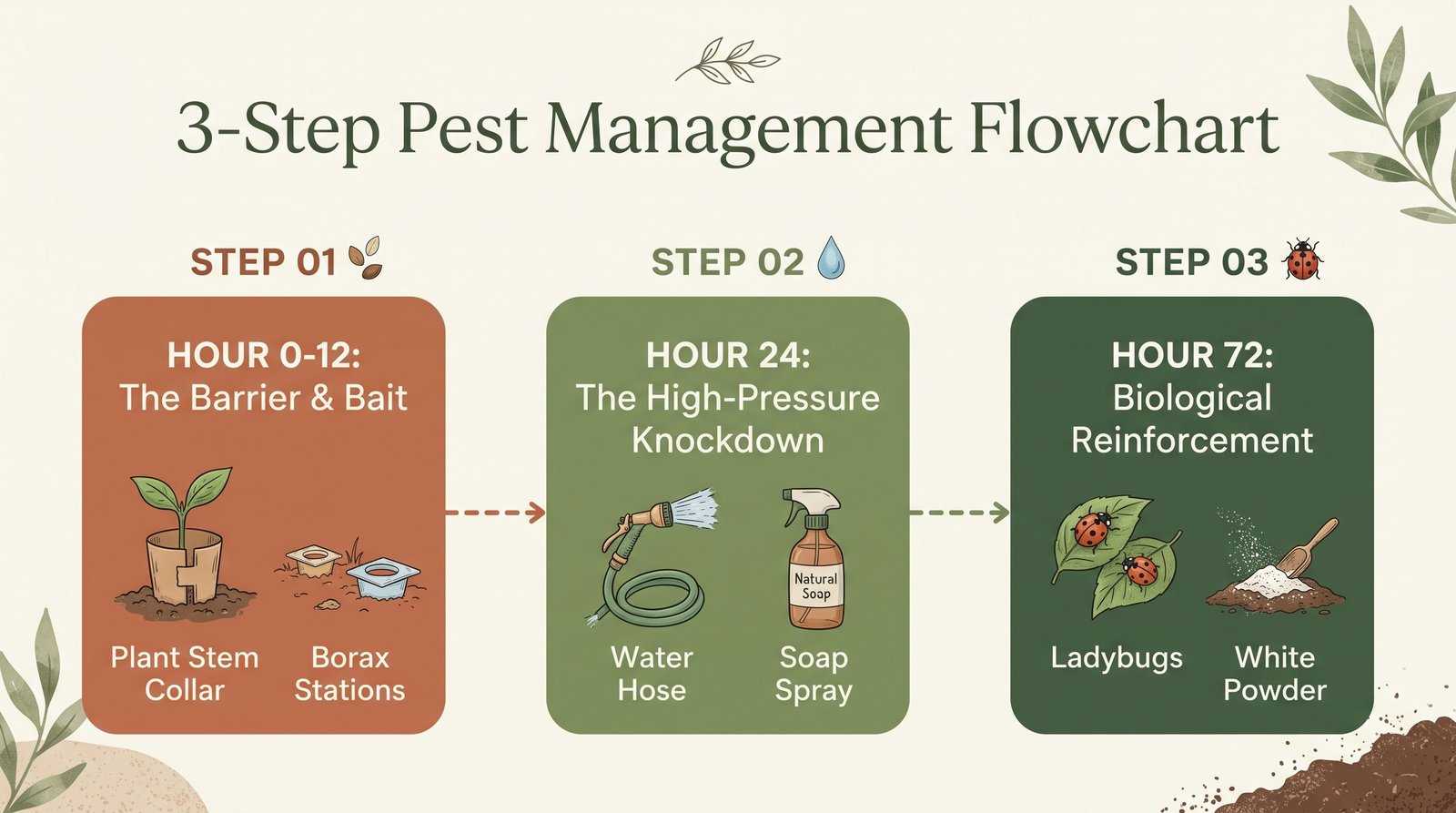
Phase 1 (Hour 0 to 12): Sever the Ant Highway & Target the Queen
You must neutralize the ants before touching the aphids. If the ants cannot reach the plant, the aphids lose their defensive guard.
Step 1: The Safe Stem-Collar Barrier
Never apply sticky substances directly to green stems.
- Wrap a 2-inch band of blue painter’s tape around the lower stem (sticky side facing out so it doesn’t adhere tightly to plant skin).
- Wrap a layer of wax paper or heavy-duty masking tape over the painter’s tape.
- Apply a thin ribbon of Tanglefoot Insect Barrier over the outer tape band.
- Ensure no leaves or surrounding weeds touch the plant above this barrier—ants will use them as makeshift bypass bridges.
Step 2: Set Rain-Safe Sugar Bait Stations
While the barrier stops them from climbing, the underground nest is still manufacturing thousands of replacements. You must eliminate the queen.
Learn the exact mixing ratios in our full borax ant killer recipe guide.
- The Recipe: Mix 1/2 teaspoon Borax + 2 tablespoons White Sugar + 3 tablespoons Warm Water.
- The Rainproof Trap Setup: Invert a small plastic sour cream container or bottle cap, puncture two 1/4-inch entrance holes on the sides, and place cotton soaked in the bait inside. This prevents rain from diluting the bait or washing boron into your soil.
Got dogs or curious cats? Avoid borax near ground level and use our pet-safe ant remedies guide instead.
Phase 2 (Hour 24): The Mechanical Knockdown & Amber Glass Spray Application
Once worker ants are blocked from the canopy, the aphids are completely vulnerable.
Step 1: High-Pressure Water Dislodgement
Early in the morning, set your garden hose nozzle to a concentrated spray. Support the backside of tomato branches with your hand and spray the undersides of leaves where aphids congregate.
[!TIP]
Aphid mouthparts are delicate feeding styluses inserted directly into plant tissue. A sudden jet of water snaps these mouthparts. Once knocked to the ground, aphids cannot crawl back up due to your stem barrier.
Step 2: The Castile Soap & Essential Oil Foliar Spray
Allow the foliage to dry for 30 minutes, then spray any remaining survivors with an organic surfactant spray mixed in UV-protective amber glass.
- Formula: 1 Quart Warm Water + 1 Teaspoon Dr. Bronner’s Peppermint Castile Soap + 5 drops pure Peppermint Essential Oil.
- Why Amber Glass is Mandatory: Pure essential oils and organic plant compounds degrade rapidly when exposed to ultraviolet light in clear plastic bottles. Plastic can also leach phthalates into your organic spray.
Recommended Sprayer: Heavy-Duty Amber Glass Spray Bottles
Protects light-sensitive organic insecticidal soaps and essential oil solutions from UV degradation. Features an adjustable leak-proof mist-to-stream nozzle perfect for spraying leaf Undersides. Check Amber Glass Bottles on Amazon →
Phase 3 (Hour 72): Biological Reinforcement & Soil Perimeter Defense
With the ant highway severed and the initial aphid population crushed, deploy living pest control and perimeter deterrents to lock down the plant for the rest of the season.
Step 1: The Zero-Loss Ladybug Release Protocol
To prevent commercial ladybugs from flying away:
- Keep the container in your refrigerator (40°F to 45°F) for 2 hours before release to calm their metabolic rate.
- Lightly mist the plant foliage with a spray bottle of water mixed with 1/2 teaspoon sugar.
- Release strictly at dusk. Ladybugs will not take flight in the dark; they will drink the sweetened droplets on the leaves and awaken at dawn surrounded by food.
Step 2: The Dry Food-Grade Diatomaceous Earth Ring
For long-lasting physical protection around the plant base, apply a 2-inch band of certified food-grade diatomaceous earth.
- How It Works: Food-grade DE consists of fossilized microscopic diatoms that pierce the waxy protective exoskeleton of ants and crawling pests, causing them to dehydrate within 24 to 48 hours. It is 100% non-toxic around organic food crops.
- Outdoor Application Rule: Diatomaceous earth must remain dry to be lethal. Read our guide on applying diatomaceous earth for ants outdoors to learn how to reapply after rain.
Organic Pest Desiccant: Pure Food-Grade Diatomaceous Earth
Certified 100% Food-Grade organic insect barrier. Safe to use around vegetables, fruit bushes, pets, and children. Creates an impenetrable physical barrier that crawling worker ants cannot cross.Check Food-Grade Diatomaceous Earth on Amazon →
Frequently Asked Questions
Can I just use vinegar spray directly on my vegetable plants?
No. While our homemade vinegar ant spray works wonders on brick walkways, patios, and foundations, acetic acid will scorch tender vegetable leaves and acidify your soil. Reserve vinegar solely for washing down garden stakes, raised bed borders, and trellises to erase ant pheromone paths.
What companion plants naturally stop ants and aphids from returning?
Interplant your garden beds with French Marigolds, Sweet Alyssum, and Spearmint (in pots, to prevent spreading). Alyssum attracts hoverflies—whose larvae eat 50 aphids per day—while marigolds emit alpha-terthienyl, a natural repellent to subterranean insect scouts.
Final Checklist: Breaking the Symbiosis
| Milestone | Action Required | Verification |
|---|---|---|
| Day 1 (Morning) | Apply blue tape + barrier collar | Confirm zero ants crossing the band |
| Day 1 (Evening) | Deploy 2 rain-covered Borax/sugar traps | Inspect for active worker ant feeding |
| Day 2 (Morning) | Jet water blast + amber bottle soap spray | Check leaf undersides for dead aphid bodies |
| Day 3 (Dusk) | Ring stem with Food-Grade DE & release ladybugs | Confirm predators are actively grazing at sunrise |
Written by Jennifer Reynolds
Certified Master Gardener • Sustainable Agriculture Specialist
Jennifer has over 15 years of hands-on experience in organic horticulture, permaculture soil biology, and non-toxic integrated pest management (IPM). Every recipe and garden strategy published on Organic Gardening Advise is field-tested in real raised beds to verify safety, dilution accuracy, and effectiveness. Learn more on our About Page.
Leave a Reply