Disclosure: This post contains affiliate links. If you purchase through our links, we may earn an affiliate commission at no extra cost to you. As an Amazon Associate, we earn from qualifying purchases.
You assume that once freezing winter temperatures arrive and snow covers your garden, ant problems are done until spring. Then one morning in mid-December, you walk into your kitchen or master bathroom and discover an organized highway of tiny black ants marching along the countertop, exploring the dishwasher door seal, or circling the pet food bowl. How are ants thriving in the dead of winter?
During late fall, outdoor colonies of odorous house ants (Tapinoma sessile) and pavement ants (Tetramorium caespitum) seek warmth and moisture. They relocate nesting satellite chambers under warm concrete sub-slabs, beneath heated bathroom tiles, inside wall voids near hot water pipes, and behind kitchen appliances. When indoor food or moisture is detected, worker scouts lay invisible chemical pheromone trails, quickly mobilizing hundreds of foragers. In this master indoor defense guide—part of our cornerstone authority framework in The Complete Pet-Safe Ant Eradication Blueprint and our Plant-Safe Ant Control Guide—we reveal how to eliminate winter ant nests permanently without spraying toxic synthetic neurotoxins around your family and pets.
Winter Ant Foraging Motivations & Intervention Matrix
| Attracting Resource | Primary Winter Location | Behavioral Signal | Best Organic Countermeasure |
|---|---|---|---|
| Free Moisture & Humidity | Bathroom sinks, showers, dishwasher seals | Ants gathering near drains & condensation | Wipe down with distilled vinegar & seal plumbing gaps |
| Sweet Carbohydrates | Kitchen pantries, honey jars, fruit bowls | Dense marching trails to specific containers | Low-concentration (5%) borax sweet liquid bait stations |
| Animal Proteins & Fats | Pet food bowls, stove grease trays | Aggressive clustering around dog/cat kibble | Food-grade DE moat around elevated pet dishes |
| Warm Microclimates | Under refrigerator compressor, sub-floor heating | Nesting frass & clustered winged swarmers | Precision amorphous silica dusting into baseboard voids |
Step 1: Destroy the Pheromone Trail Immediately
When you squish an ant, other ants don’t flee—they follow the chemical trail laid by the scout. Merely wiping ants away with a wet paper towel leaves the invisible hydrocarbon scent trail intact on your countertop. To erase the scent highway, spray the trail with a 50/50 mixture of distilled white vinegar and water with 5 drops of pure peppermint or tea tree essential oil.
The acetic acid neutralizes the alkaline scent molecules instantly, disorienting foragers and causing them to scatter. For full details on vinegar formulations, read our Vinegar Ant Spray Guide.
Step 2: Low-Concentration Borax Baiting (The Colony Killer)
Spraying contact killers only kills 5% of the colony (the foraging workers), leaving the queen safe inside her warm wall void to lay hundreds of replacement eggs. To achieve permanent eradication, you must use a slow-acting metabolic bait that workers carry back to feed the queen via trophallaxis.
The secret is using a low concentration (5% or less) of pharmaceutical-grade borax or boric acid. If the bait is too strong, worker ants die before returning to the nest. Mix 1/2 teaspoon of borax with 1 tablespoon of warm honey or maple syrup and 2 tablespoons of warm water. Place the bait inside a puncture-proof container with 1/8-inch entrance holes tucked safely behind the refrigerator or under sink vanities. Read our recipe in Borax Ant Killer Recipe.
Certified Food-Grade Diatomaceous Earth with Precision Duster
Apply an invisible, non-toxic mechanical barrier along kitchen baseboards, under dishwasher kickplates, and behind appliances.
Dr. Bronner’s Pure Liquid Castile Soap
Disrupts ant surface tension and cleans kitchen countertops without leaving toxic chemical residues where pets and children eat.
Pure Organic Peppermint & Rosemary Essential Oils
A powerful natural repellent that blocks ant scent receptors when sprayed around foundation cracks and plumbing pipe entries.
Step 3: The Food-Grade Diatomaceous Earth Perimeter
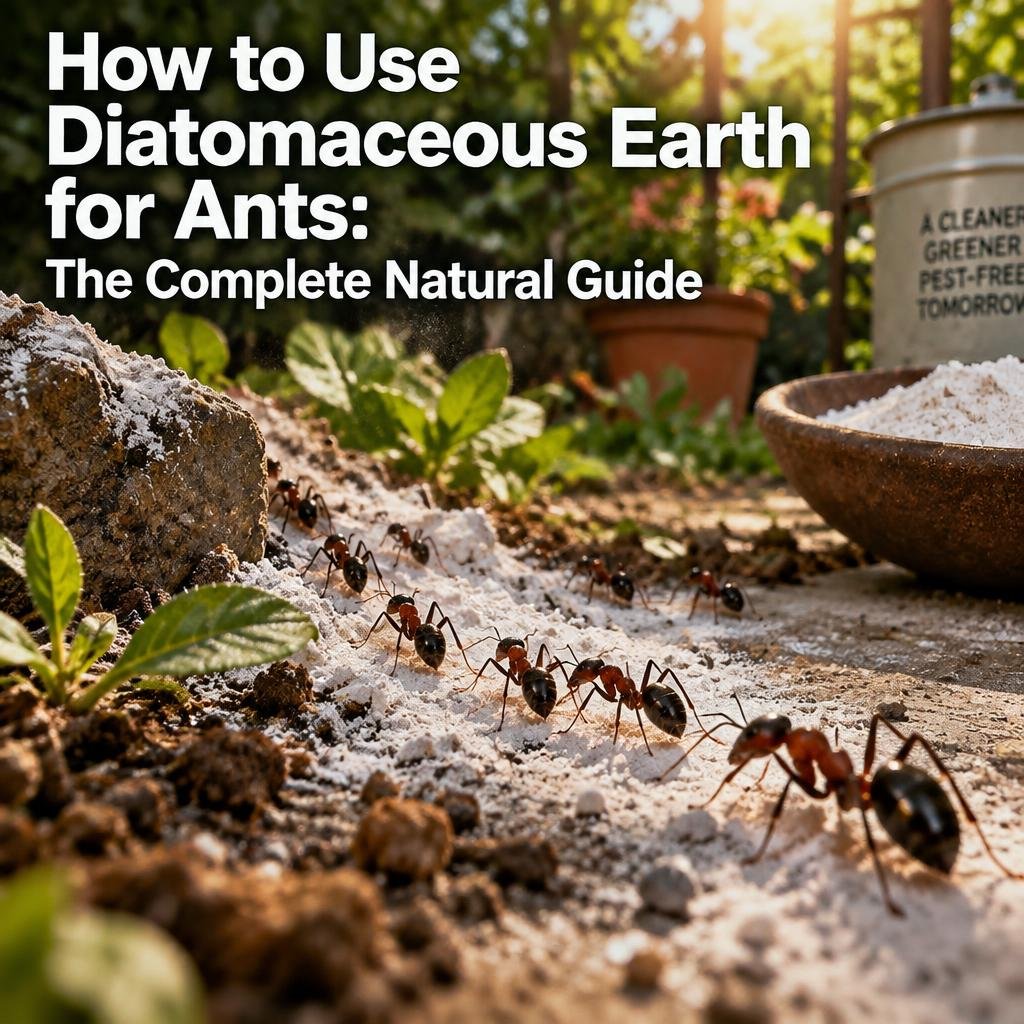
Use a rubber bulb duster to inject an ultra-fine dusting of certified food-grade amorphous silica into the hairline gap between your baseboards and flooring, behind electrical outlet faceplates, and around pipe penetrations. Diatomaceous earth acts as an indestructible microscopic barrier: any crawling ant that crosses it suffers fatal exoskeleton desiccation within 24 to 48 hours.
Download the Free Organic Pest Prevention Checklist & Spray Chart
Get instant access to our printable organic dilution cheat sheets, companion planting matrix, and seasonal pest calendar used by certified organic growers.
Frequently Asked Questions
Why are ants attracted to my bathroom during winter?
Indoor heated air dries out home interiors. Ants require constant water to survive. Bathrooms provide warm, humid microclimates with moisture condensation around shower drains, pipe traps, and sink faucets.
Is borax bait safe in homes with curious pets?
Borax can be toxic if ingested in large quantities by pets. Always place liquid baits inside tamper-resistant stations (like a sealed plastic container with small side holes) located in areas inaccessible to dogs and cats. For complete safety guidelines, consult our Pet-Safe Pest Protocol.
Written by Jennifer Reynolds
Certified Master Gardener • Sustainable Agriculture Specialist
Jennifer has over 15 years of hands-on experience in organic horticulture, permaculture soil biology, and non-toxic integrated pest management (IPM). Every recipe and garden strategy published on Organic Gardening Advise is field-tested in real raised beds and container gardens to verify safety, dilution accuracy, and effectiveness. Learn more on our About Page.
Leave a Reply